

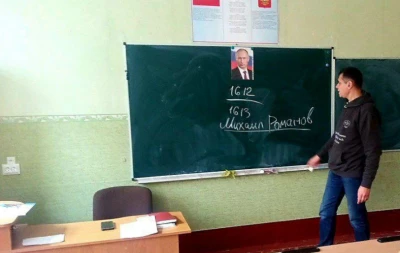
In the occupied territories of Luhansk oblast, schools received manuals on conducting extracurricular activities"Talks about important things" with pupils. This program is unique for the Russian Federation and the temporarily occupied territories - from Crimea to Donbas. Not so many people paid attention to a significant detail: the course is based on the National Security Strategy of the Russian Federation and its main fear: the dissolution of the Russian Federation.
It is known that the occupiers pay special attention to the education system. Education is as important for them as military operations. For example, this year, the largest number of Russian citizens among those who were appointed to″ the government of the Luhansk People's Republic″ received positions exactly in ″the Ministry of Education″ ─ the Russian "minister" Ivan Kusov and his two deputies Pyotr Ishkov and Yevhenii Miroshnichenko are also among them. Therefore, the Russian Federation considers education to be a vital occupation methods.
However, in this case, we are talking about something more serious than simple attempts to integrate children and teenagers in the occupied territories into the "Russian world". We carefully analyzed the "Sample work program of the extracurricular course "Talks about important things", delivered to the schools in Rubizhne and Sievierodonetsk (thanks to several school directors).
So, what have homerooms to do with national security?
The program contains no mention of the occupied territories of Donbas - only about the "reunification of the Russian Federation with Crimea": this manual had been developed before the "referendum" on the accession of the "republics" to the Russian Federation took place. There is also no mention of a "special military operation." Firstly, the "special military operation" was proposed to be discussed in the typical scenario of the lesson "Our Country - Russia" on September 12, and then, according to Mediazone, this phrase was omitted as well.
At the same time, this program was developed, as written in the introduction to the brochure, to implement the National Security Strategy of the Russian Federation. The regulatory framework of the program includes a list of documents, where the National Security Strategy of the Russian Federation is the first one, and half a dozen orders of the Ministry of Education of the Russian Federation and other trifles are further down the list. The Kremlin explained that "the new homerooms would be devoted to the values enshrined in the National Security Strategy."
What are the values? What have homerooms to do with national security?
The word "values" appears 27 times in the text of the National Security Strategy of the Russian Federation, and almost everywhere with the clarification "traditional". They are mentioned in connection with the fact that "a number of states are trying to purposefully give a false idea of traditional values", and the Russian Federation "preserves", "strengthens" and "protects" them. This is established in the lists of national interests and priorities. A separate chapter of the document is devoted to the protection of "values", where the list is attached:
https://base.garant.ru/401425792/
or
http://static.kremlin.ru/media/events/files/ru/QZw6hSk5z9gWq0plD1ZzmR5cER
"Traditional Russian spiritual and moral values include, first of all, life, dignity, human rights and freedoms, patriotism, citizenship, service to the Motherland and responsibility for its destiny, high moral ideals, a strong family, creative work, the priority of spiritual over material, humanism, mercy, justice, collectivism, mutual aid and mutual respect, historical memory and succession of generations, unity of the peoples of Russia. Traditional Russian spiritual and moral values unite our multi-ethnic and multi-confessional country". (Highlighted by us. - Ed.)
The Ministry of Education must develop an "antidote"
There are two key things: the "unity of the peoples of Russia" and the fact that values together "unite the country." The theme of national unity is the main idea of the National Security Strategy of the Russian Federation.
Chapter II. "Russia in the modern world: trends and opportunities" paragraph 12 states that now "The territorial integrity and sovereignty of the country are ensured at an appropriate level ... Attempts of external interference in the internal affairs of the Russian Federation are effectively curbed." Further, in paragraphs 20 and 21 it is emphasized that exactly foreign states are making efforts to undermine the national unity of the Russian Federation and provoke long-term instability.
Chapter III. outlines the main fears of the Kremlin "National interests of the Russian Federation and strategic national priorities." In short, it is the fear of the dissolution of the Russian Federation.
Paragraph 25 sets out the national interests of the Russian Federation. Protection of state and territorial integrity takes the second place, maintenance of civil peace and harmony in the country ─ in 3rd place, protection of information space from "destructive information and psychological influence" ─ in 4th place. (In total, there are 8 of them ).
There are no details, but "territorial integrity" alongside "civil peace" hint that it is not only about maintaining the occupied territories (first of all, at the time of the signing of the document in July 2021 - the Autonomous Republic of Crimea , and now also the "joined" parts of the Kherson and Zaporizhzhia oblasts and "LPR", "DPR").
Actually, it refers to keeping the subjects of the federation as part of the Russian Federation, opposing the national liberation movement of the indigenous peoples of the Russian Federation, and simulating national unity by clearing the information space.
Therefore, pupils in the temporarily occupied territory of Luhansk oblast will be taught to share precisely these values: patriotism towards the Russian Federation, service to the Russian Federation and the unity of the peoples of the Russian Federation. So, the goal of such education is to prevent the dissolution of the federation.
Existing centrifugal tendencies in Russia, of course, does not mean that the dissolution will happen in the nearest future. (However much we want the aggressor state to cease to exist.) At the same time, this fact should be understood, and Ukraine should really take certain measures aimed at undermining the "national unity" of the Russian Federation.
Regarding the "patriotic" education for children in the temporarily occupied territories, the Ministry of Education of Ukraine should take this into account and start developing an "antidote" that will heal the ideological wounds inflicted by the occupiers.
Author: Oleksandr Bielokobylskyi