
"I remember walking home from school. Hungry. I know that at home, perhaps, there will be tortillas from the forehead. I walked for a long time, occasionally losing consciousness. It was a stroke of luck to meet one of the relatives, because they would definitely give at least a crumb of bread or a piece of beet, feeling sorry for me, the little one", - Ludmila Klimenko from Lugansk recalled about the famine. My grandmother. This is almost the only thing she told about those times in her life. They were afraid to talk about Holodomor.
TRIBUN’s journalist talked to historians, local historians, asked fellow countrymen and collected in one text everything she learned about Holodomor in Luhansk oblast.
The villages suffered the most
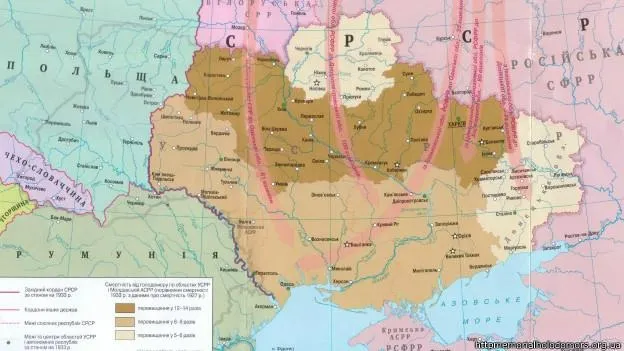
Historians of Luhansk oblast Oleksandr Naboka and Valerii Nehmatov agree that about a quarter of the population died in Luhansk oblast during the famine of 1932-1933. However, it is impossible to obtain exact figures while the archives are under occupation.
It is also worth noting that the famine in Luhansk and in the villages of Luhansk oblast varied.
"In the city there were more chances to survive than in the village, more opportunities to find work at least for food. The dead were mostly villagers. There were whole extinct villages", - says Olexandr Naboka.
The most frightening consequences of Holodomor were in Verhneteplivskyi, Novopskovskyi, Starobelskyi, Bilovodskyi and Rubizhne districts.
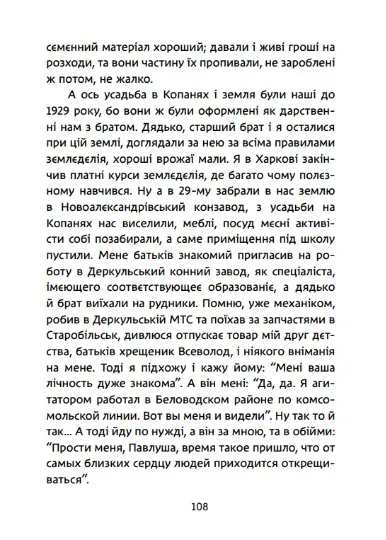
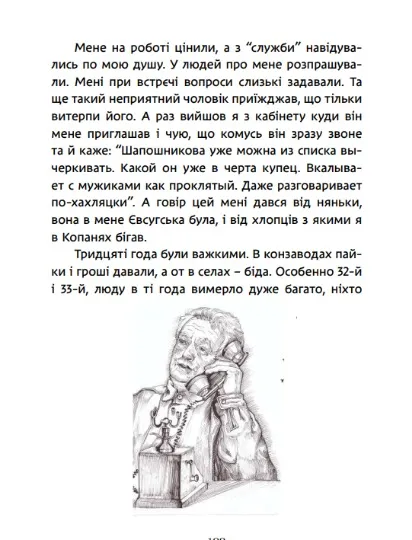
"The thirties were hard. In stud farms rations and money were given, but in the villages - it was a disaster. Especially the 32nd and 33rd, a lot of people died out in those years, no one will probably say how many of them then hunger put in the damp earth. There was no talk of mail for the dead, really there were enemies who bypassed their precincts and, according to surveys of people, faithfully filled out formulars and later such documents disappeared" - from the memoirs of the resident of the village Novoderkul-Vitrohon, Shaposhnikov Pavel Oleksievich, 1907 - date of birth (recorded in 1976) Vera Annusova.
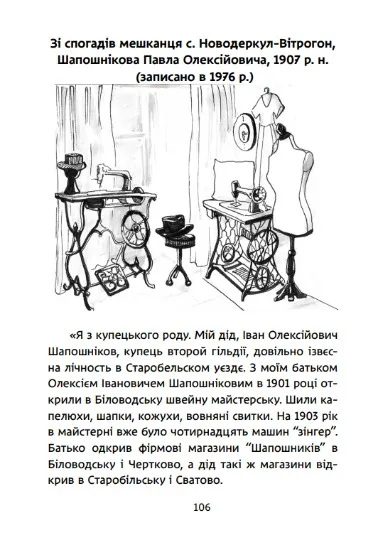
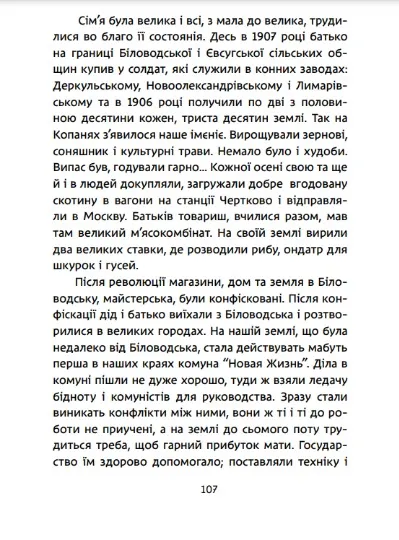
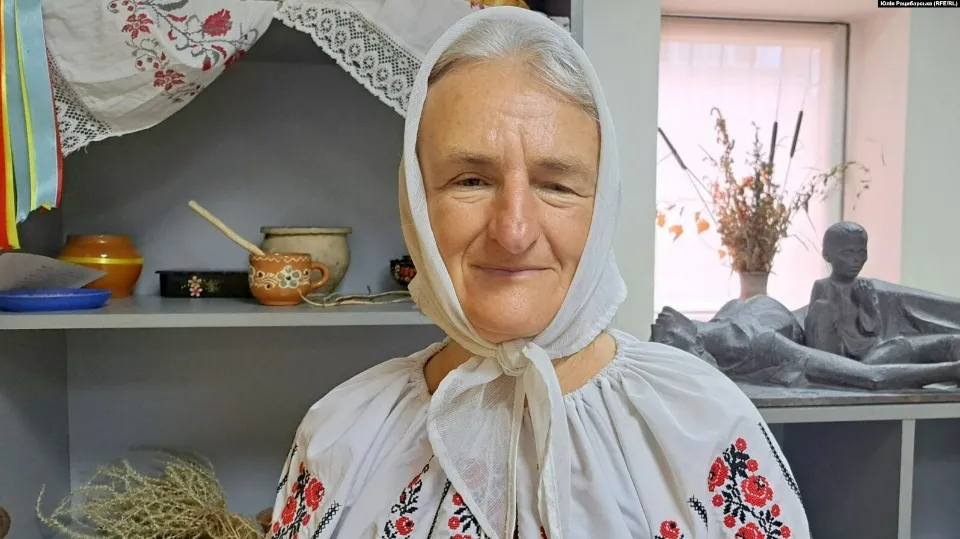
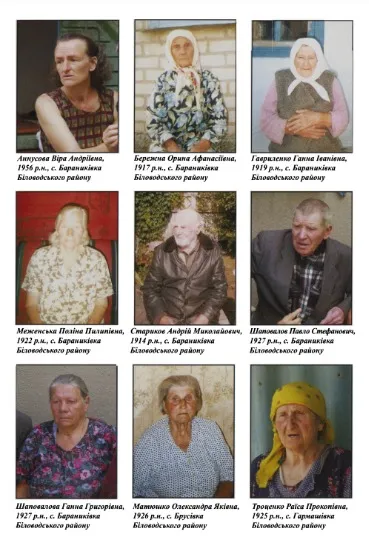
Vera Annusova is a teacher of mathematic and physics, an indigenous resident of Belovodschyna, who gave impetus to "green tourism" in her native land and has already resettled from the east to Dnipropetrovsk region. In 2014, Mrs. Vira and her husband moved because it was dangerous for people with a pro-Ukrainian position who helped the military to stay at home. At first, the couple ended up in Tsarichanka, and now they live in Petrikovka, Dnipropetrovsk oblast. Now she is a researcher at the Museum of Resistance to the Holodomor. Mrs. Vira devoted most of her life to collecting information about the Holodomor in Luhansk oblast. She personally went from house to house, carefully listened to and recorded stories that resulted in the collection "Ukrainian Village of the First Half of the 20th Century through the Prism of Human Memory: From Collections of Memories Collected by Vera Annusova." The book was published in the early 90s and now the educator is working on the next one.
"The first information about the coup, our revolution, and the peasant war, the years of the NEP, the destruction of our spiritual culture and about dispossession, collectivization, famine, of course, I received from my relatives," says Vera Annusova.
At first, as a child, she just listened, and then began to record a little.
"And then I was banned from doing it. People were scared. They said that you can not record, it is better to keep in memory. Even before the war, my grandmother's neighbor, Ivan Antonovich Dreev in Nyzhnia Baranikovka, served 10 years for publicly speaking about the Holodomor. In 1953 he was rehabilitated, he was my teacher, "says the researcher.
If we talk about Bilovodshchyna, then, according to Mrs. Vera, part of the population survived at one time thanks to the stud farms of Luhansk oblast.
"I grew up on a farm next to the third branch of the Derkul stud farm and heard a lot of stories there. So people went from Baranikovka and Nizhnia Baranikovka to the Varka farm, where the second branch of the Derkul stud farm is located, behind horse heads, "says Mrs. Vera.
According to Annusova, she had a conversation with the veterinarian and the breeder of the Derkul stud farm Cherkasov Veniamin Havrilovich, who told her how horses saved people in 1933, when the borders were closed and the inhabitants of Luhansk oblast could no longer go to Rostov region to exchange something for food or for alms.
"He is a very wise man, once he said that horses are very sensitive to human grief. In early 1933, horses began to disappear. Well, not from sores, but from heart attacks. They could not bear such human misery. And therefore, these people in the surrounding villages actually survived due to horse meat "the researcher notes.
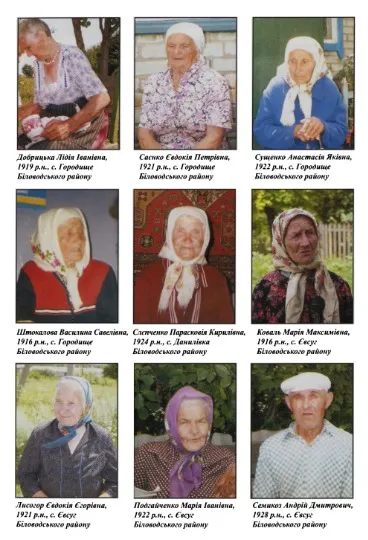
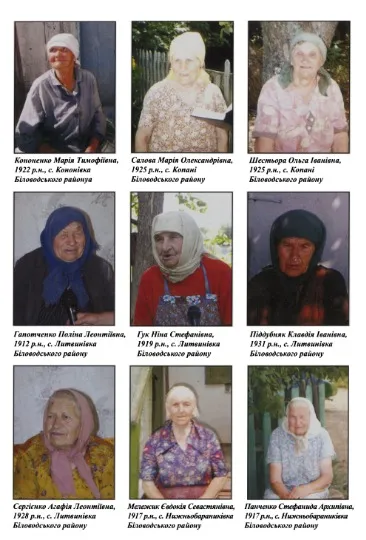
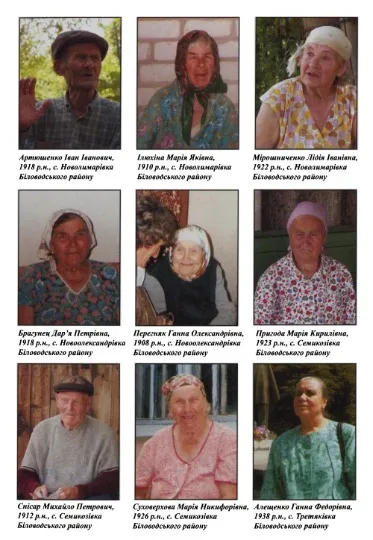
Nowadays Vira Annusova works at the Museum of Resistance to Holodomor in Dnipro, where you can go for a study tour.
"We have this museum, and you know, people come. At first we were told that no one would go to you, and no one needed it. But they were wrong. We have many visitors, although our room is very small.
In Luhansk memory was rolled
"In general, many people in Luhansk kept silent about the famine. Grandmother says that when she said at school in 1935 that there was a famine, that her sister was buried in a mass grave, they poked at her and told her not to invent, they say, there was no famine, and if they were starving, it was because of lazy parents. My grandmother cried so bitterly, because her family was disciplined: in 1932 pigs and all the grain were taken away, only one cow and a few chickens were left to the family, "Oksana Onyshchenko, a resettler from Luhansk, shares her family story.
For the first time in Luhansk, they publicly talked about Holodomor shortly before the Husinovskyi," which is now known as a park called "Friendship of Peoples." The cross stood for less than a day. At night he was kidnapped by unknown people.
"They didn't talk about it publicly. I was born in the late 60s in Luhansk. The fact that there was once a cemetery on “Druzhba” was learned only from her grandmother shortly before her death. Once I went through the photos, I began to ask who was in the photo and she cried and told her to go to that park with her foot, because there her younger sister was lying with the rest of the murdered by hunger in 1932, "says Oksana Onishchenko.
There they buried not only those who died of hunger, but also those tortured in the city NKVD.
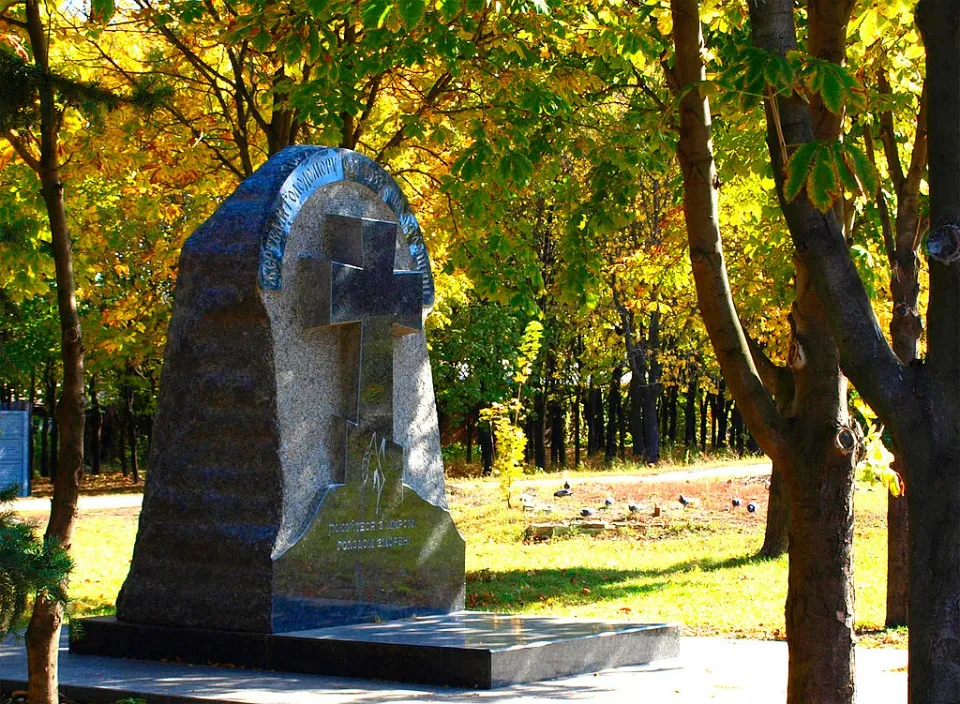
In 2007 Holodomor was again talked about publicly. In Luhansk, in the same cemetery-park, there was a memorial sign to the victims of the Holodomor, which was opened by the President of Ukraine Viktor Yushchenko during his March visit to Luhansk.
The elderly or their children began to recall terrible details about the times of continuous hunger.
"My grandmother said that during the famine there was a market in the center of Luhansk, now that place is called" Durakovka. " She said that there was some philanthropist named Durakov, he cleared the territory there for the market and organized everything. From there the name went. She always laughed at the theory of Soviet power that "Durakovka" was "because the youth there fell foolishly." So there, according to her, they sold manyatina. Of course not openly but who wanted he could buy. She said that the policemen tried to catch everyone, but there was a demand, so there were sellers of such "fresh food." Terrible things happened. People survived as best they could, "says Mrs. Onishchenko.
Now, near the place that is still called by the people - "Durakovka" - is the building of the temporarily occupied regional council of Luhansk. And in place of the market - trees rise, because the Soviets built a park there.
"At one time, somewhere around 2015-2017, SBU actively published the NKVD archives about Holodomor, collectivization, dispossession, peasant uprisings and including cannibalism. All this was inherent in the Luhansk region. All that was in other regions - so it was with us, "says historian Olexander Naboka.
"Luhansk was an important industrial center, so there was a card system. It was clear that there was not enough food for everyone, but not as critical as in the villages. From time to time, people appeared in Luhansk, as in other industrial cities, who were lucky to move to the city from the village under various pretexts. As in other cities, they did not recommend walking there with a loaf of bread, because they just could have hungry people start attacking, "says olexander Naboka.
The historian told the story of his family during Holodomor.
"All the surrounding villages still tried to move to Luhansk and find work. Yes, in fact, and my ancestors once did. Their first house, when they moved from the village of Makarov Yar to Luhansk during Holodomor, stood on the site of a modern cinema of the OP plant, "says Naboka.
He notes that this branch of the family was saved by work at a factory in Luhansk and the other in the village of Timonovo, Troitskyi district by the fact that the great-grandmother was a midwife.
"People were still giving birth during the famine.So for delivering babies, people in gratitude brought some grain, someone bread, someone something else. My grandfather was with her, so it saved them. Grandfather also recalled that they caught, ate gophers (gophers). In the gardens, they even searched for bones from cherries, from plums, broke and somehow ate. There was such a herb - "hare ears" -the same was consumed in food, "says Mr. Olexander.
Historians emphasize that many fled from hunger to neighboring Russia - Moscow, Voronezh, Rostov region, Taganrog because there was bread. This concerned not only Luhansk, but also the entire region, there is evidence of this in the form of testimony.
"On the hunger strike of 1933, I was not swollen, I drove kerosene from the station and stole a little, and changed it for food. And then a telegram came from my brother in Belarus, he was an officer, serving in the military there, it said "Come urgently". I went. There was no famine. My brother got me a job as a guard in the unit. And as my brother learned about the famine with us, they did not write about it either on the radio or in the newspapers. He says that the frequent commander from Moscow comes and says: "Find out, Starikov, whether your relatives live in Ukraine. There's a famine raging there. . People in villages are dying. " My brother immediately sent me a telegram. I went. Saved my brother from starvation. In 1935 I was taken to the personnel. He returned home already in the 47th, "- from the memories of a resident of the village Baranykivka Andriy Starikov.
Settlement in the homes of the dead
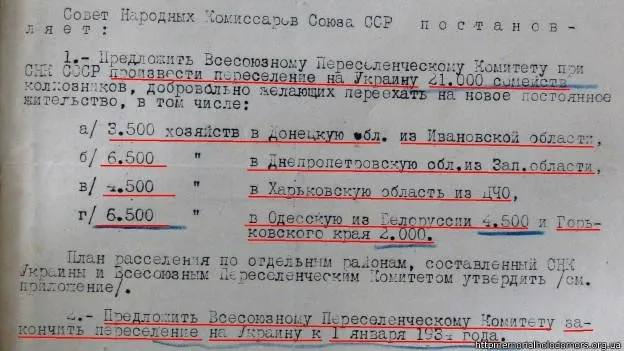
From the second half of 1933, Ukrainian cities and villages affected by hunger began to be settled by immigrants from Russia, Belarus and the current western regions of Ukraine. This was preceded by the decree of the Council of People's Commissars of the USSR "On resettlement to Ukraine of 21 thousand families of collective farmers" dated October 25, 1933.
For resettlement it was allocated 15 million 500 thousand rubles.
According to archival documents, collective farmers from Russia had to move to Donetsk (then extended to the territory of the current Luhansk region), Dnipropetrovsk (to which the current Zaporizhzhya region partially belonged) and Kharkov regions, and to Odessa (then extended to the territory of the current Nikolaev and Kherson regions) - from Belarus and Russia. They were literally echelons of people!
"We were taken into the house, we climbed on the stove, and they made cookies - apparently there were children here. And as people died out, everything - bedding, everything remained," she says. We were fooled too. It was there that we, in Chernihiv, were told that there in the East people were lazy, they did not want to do this, but the land was fertile and the bread was white. We, he says, have rye bread,but here it is white. And they brought us bread (they showed us which of our wheat can be baked), and we, he says, arrived. And when we arrived at Chertkovo station, here people already told us: "Where are the devils taking you? But here, they say, people die like flies! "- Natalia Khrapata from Zelykivka shared her testimonies about the Holodomor to the book" Saved Memory. "The memory was recorded by Vira Annusova.
The IDPs were placed in better conditions under those who were able to survive the Holodomor - they were provided with financial assistance, exempted from paying agricultural taxes for the first three years and for a year - from the supply of milk and meat to the state. Families settled in empty huts, the repair of which had to be done by local collective farms. If the settlers did not have a cow, they gave one per family and one horse for several families.
Also, if the family was able to escape from hunger, for example, to neighboring Russia, and at the end of the famine decided to return, then they could no longer settle in their house, if immigrants already lived there.