

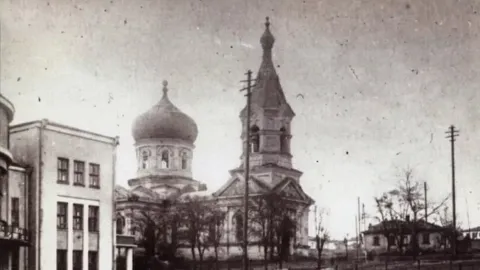
The second "five-year plan," unofficially dubbed the "godless" plan, declared by the leadership of the USSR from 1932 to 1937, saw a significant decline in religious buildings in territories under Soviet control. By the end of 1937, the number of religious buildings in areas occupied by Soviet authorities had decreased by 58%.
The liquidation of the Ukrainian Church was another method by which the Soviet government sought to eradicate Ukrainian identity among the population in the occupied territories. Read about what was destroyed by the communists in Luhansk region and what examples of church architecture from the region we have lost forever in TRIBUN article.
St. Nicholas Church in Bilovodsk
The most prominent landmark in modern Bilovodsk is the Holy Trinity Church located in the very center of the settlement. However, not many people know that prior to the October Revolution and the Soviet occupation, there was another church in the locality - the St. Nicholas Church. According to information from local archives, the wooden church was built by local residents as early as 1767 in a district known as "Pishchanyvka" (presumably, a local name for one of the districts of the settlement).
By 1853 parishioners of this church began the construction of a new stone structure to replace the old wooden one. The construction was overseen by villagers Hrihorii Korolenko and Ivan Snisar. According to information from the State Archives of the Kharkiv Region, the church was completed in 1866.
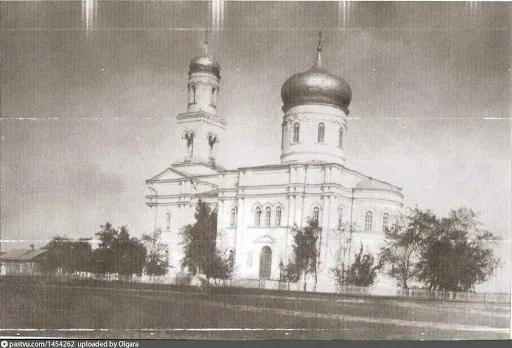
After its construction, a decision was made to open a school at the church, and by 1916 60 boys and 31 girls were attending classes there. In further history, the square near the church became a place for trade, rallies and even a center for revolutionary uprisings.
The only photograph of the St. Nicholas Church that we managed to find is dated to the first half of the 20th century.
Already in 1922 when the first famine ravaged the territory of the USSR due to excessive spending caused by the First World War, the process of looting church property began. Local activists and komsomol members confiscated cult objects made of precious metals for the benefit of the state. Later, in December 1927, when Stalin declared that "atheism must be militant, and anti-religious agitation aggressive," the local atheist group "Atheist" began the process of closing churches in Bilovodsk.
"The bells were taken down from the belfries of the Trinity, St. Nicholas and Assumption churches, church property and iconostases were destroyed, icons were smashed and burned - everything that happened resembled the actions of barbarian vandals who destroyed monuments of ancient culture in Rome in the 5th century. All churches were closed, priests were expelled, and parishioners were intimidated. Demolishing monumental memorial structures became a traditional practice from that time," wrote historian and local lore researcher Volodymyr Stepanov.
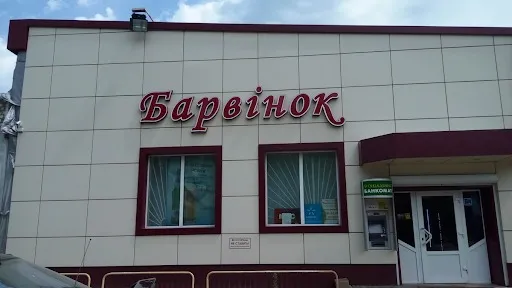
In 1937, the St. Nicholas Church in Bilovodsk was dismantled, and using the remaining materials, the building of Bilovodsk High School No. 1 "Leader" was constructed on the site of the church - later, a bakery was established. The remnants of the stone were used to pave Central Street (formerly Lenin Street). Currently, the site of the St. Nicholas Church is occupied by the "Barvinok" store.
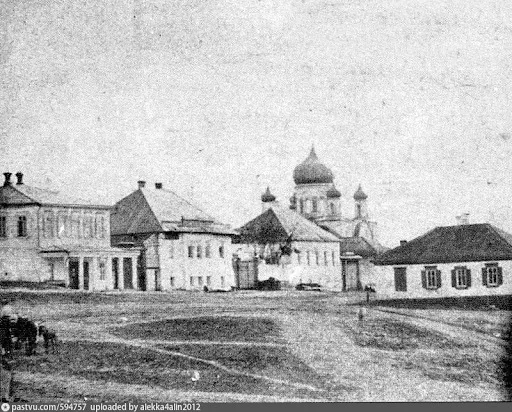
Cathedral of the Kazan Icon of the Mother of God in Luhansk
In 1861, the construction of another Orthodox church in Luhansk began– the Cathedral of the Kazan Icon of the Mother of God, the only church in the city with five domes. The construction was financed by merchants and townspeople.
The construction took 3 years and by 1864 services had already begun in the church. The parishioners of the church were mostly wealthy residents of Luhansk who lived in the city center.
With the advent of Soviet power in Luhansk, as well as throughout Ukraine, persecution of the church began. In 1935, the communists attempted to blow up the church, but only the walls collapsed due to the explosion while the foundation remained. For more than half a century, the site of the cathedral was a wasteland, and in the early 2000s, a decision was made to restore the church.
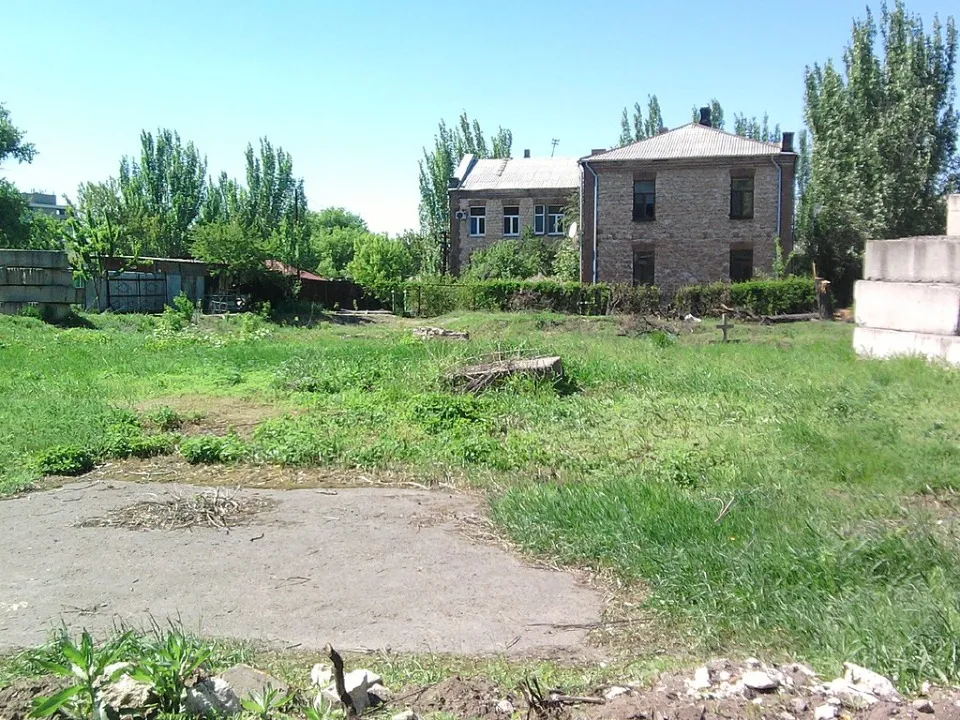
Wasteland at the site of the Cathedral of the Kazan Icon of the Mother of God in Luhansk
In 2014, a project was developed, and the foundation was laid for the administrative building on the site of the temporary premises of the Holy Kazan Temple. However, due to the hostilities and the beginning of the Russian occupation of Luhansk, construction was halted.
Voznesensk Church in Luhansk
The stone Voznesensk Church was built on the outskirts of Luhansk on the territory of the cemetery in 1905. It was funded by the merchant Fedor Pidkopaiev, who allocated 1250 square fathoms of land for its construction. Since 1927, the parishioners of the church were subordinate to the Ukrainian Cathedral-Episcopal Church.
A photo of the church is dated 1905.
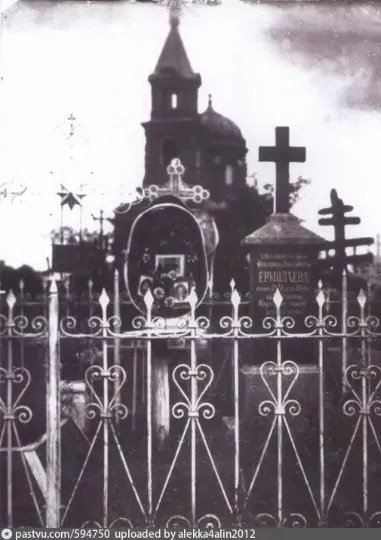
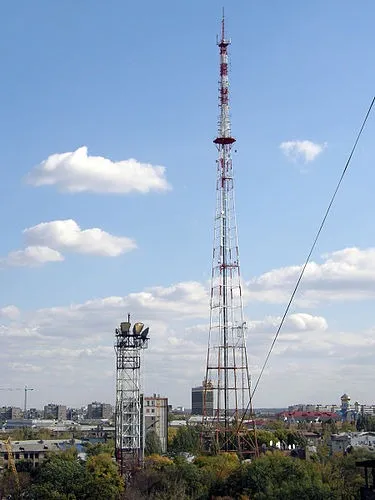
The destruction of this structure was justified by the communists as the reconstruction of the city center. The cemetery was closed, reburials were carried out, and the church was blown up, and after 1935, it was completely demolished. Currently, a television tower is located on its site.
Transfiguration Cathedral in Luhansk
The Transfiguration Church in Luhansk was opened in 1897 in a relatively populated working-class district of the city, known locally as Husynkivka. The Transfiguration parish also included the Oleksiivska Church, which cared for the prisoners of Luhansk Prison located in Husynkivka.
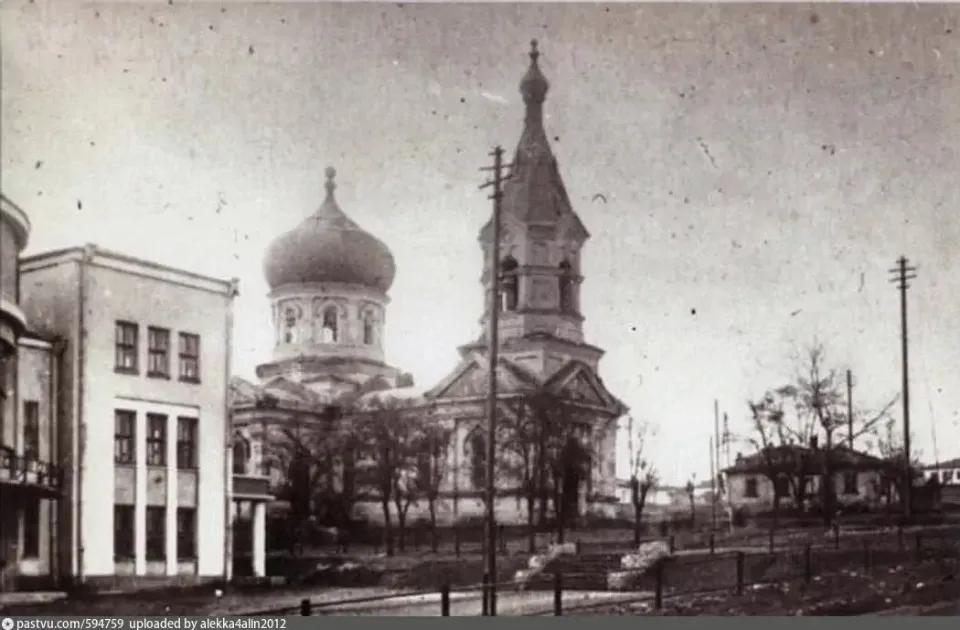
The church was closed on December 30, 1920, by the decision of the Secretariat of the All-Ukrainian Central Executive Committee . It was sealed off, and its religious property was transferred to the communities of other churches in the city. Some of the property ended up in the Metalist Club and the city theater, where sacred items were used for decorations. The belongings that supposedly "had no historical value" were destroyed – according to the archives, 2350 kilograms of copper from the bell tower, 360 kilograms of brass, 39 kilograms of bronze, and 230 kilograms of iron were handed over to Rudmetalltorg.
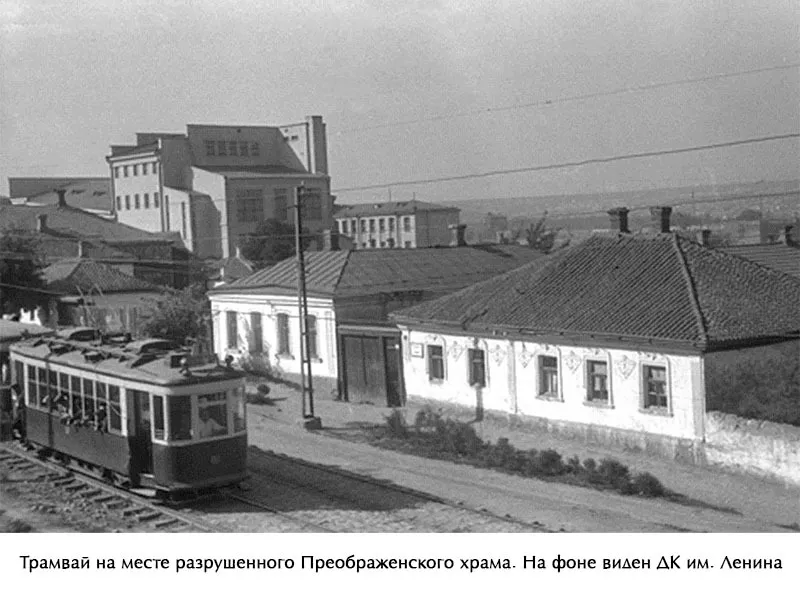
According to one version, the church building was planned to be used as a cinema, but it was demolished due to the construction of the city's first tram line. According to another version, the church was demolished because it was higher than the Lenin Palace of Culture, built in 1929. In any case, in May 1934, the church was blown up, and in September 1934, the first tram passed through the site.
St. Andrew's Church in Svatove
St. Andrew's Church was located in the center of the market square of the former settlement of Svatova Luchka (now the city of Svatove), the building was not constructed "from scratch"; it was converted from the headquarters of the Cuirassier Division (a unit of heavy cavalry in the Russian Imperial Army). The building was sold to the community after the dissolution of military settlements, and with the help of wealthy locals, it was converted into a church.
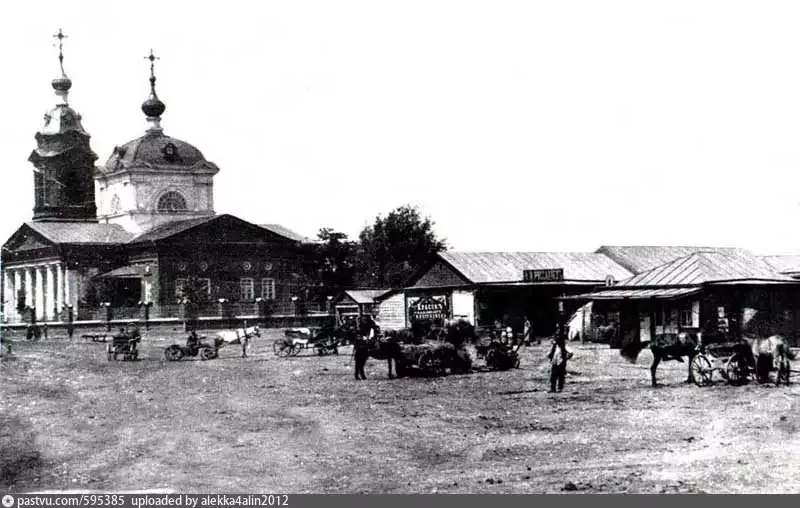
On June 29, 1869, the church was consecrated in the name of the Exaltation of the Holy Cross, but later it was reconsecrated in honor of the Venerable Martyr Andrew of Crete, and since then it was known as St. Andrew's Church. According to the recollections of the town's residents at the time, the church had a very good heating system that warmed the entire floor of the temple, providing a warm shelter even during the coldest winters. Near the church, there was a building housing the church-parish school and the seminary, which is now the building of Svatove Secondary School No. 1.
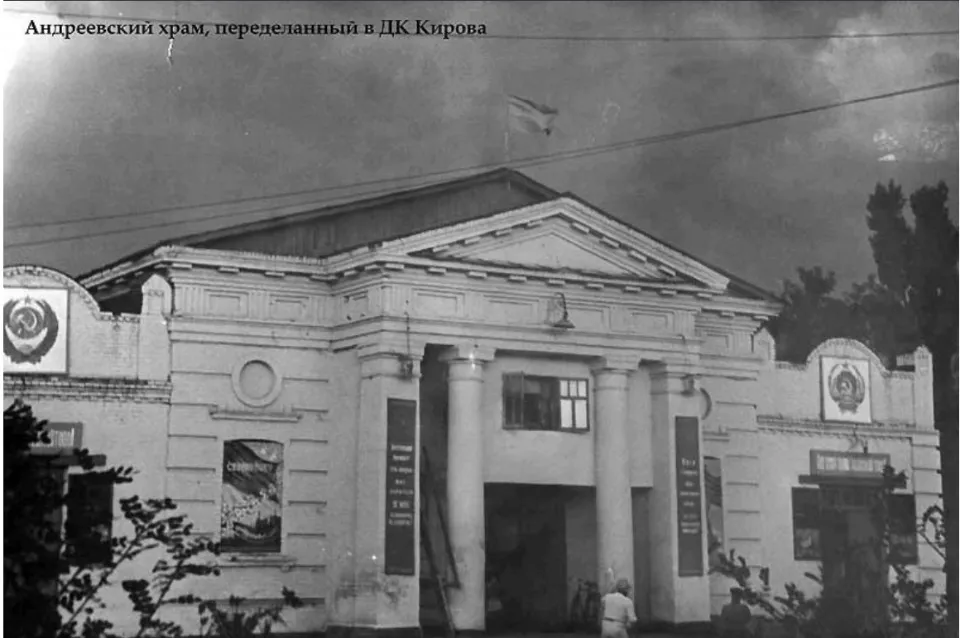
This church operated until 1935, but the communists did not destroy it; they only closed it and carried out reconstruction, after which the church building was used as a district house of culture. Unfortunately, the church did not survive to our time – in 1976, the building was dismantled after a fire. Only testimonies of people who participated in its reconstruction into a house of culture have been preserved.
"The faces of the saints depicted under the dome could not be painted over. These faces were painted on the walls in round frames. They tried to paint coats of arms of allied states over them, but the faces of the saints kept emerging through the paint," witnesses recounted.
Svatove. Cathedral of the Descent of the Holy Spirit
Another church structure with an interesting history was the Cathedral of the Descent of the Holy Spirit, built in 1822 on Cathedral Square in the former settlement of Svatova Luchka (now the city of Svatove). The backstory of this church is as follows: there once existed an ancient wooden church in the settlement, which was in an extremely poor condition due to its age. Attempts were made to rebuild and relocate it, but it did not last long. The archival documents recorded: "...in 1793 in Svatove Settlement, during the construction of a new church, they used the wood from the old church. On July 6, 1810, liturgy was served in it, and as soon as everyone left the church, it collapsed completely. This strange sign of Divine Providence stirred in all the residents of Svatova Settlement a desire to express fiery gratitude to the Lord by building a new stone church, which they immediately sought blessing for from Bishop Christophor..." This new church became the Cathedral of the Descent of the Holy Spirit.
Until the 1930s, the cathedral was the pride and beauty of the city of Svatove. In the early next decade, it was destroyed and dismantled, but the details of the demolition were not specified in the sources.
"It was a brick five-domed church, built in classical forms with two large pediment-portals, supported by four columns to the south and north above the entrance to the prayer hall. The main entrance was from the west. There was a bell tower above the entrance, but it was not of the tower type, as was typical in the 19th and early 20th centuries, but of Novgorod architecture; that is, there were arches for bells, where up to 6 bells of various sizes and tones were placed. Around the church was a stone fence with brick pillars, between which were stone walls with recesses. Small sturdy gates were located to the north and south. The main entrance through the fence from the west was a small arched gate with wings on both sides," recalled Hanna Smerchynska, an architect and native of Svatove.
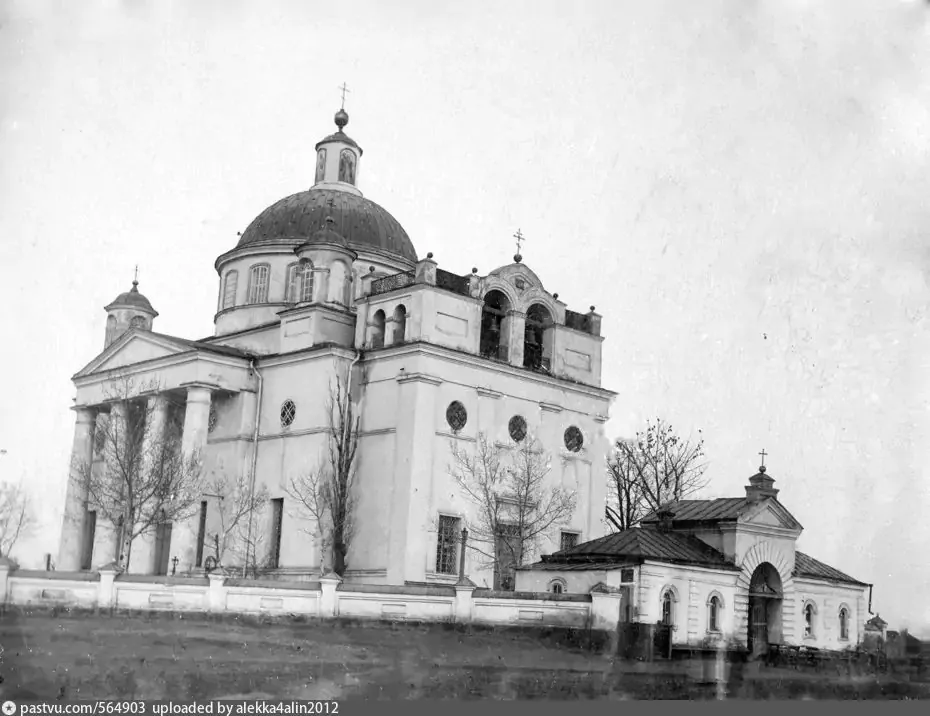
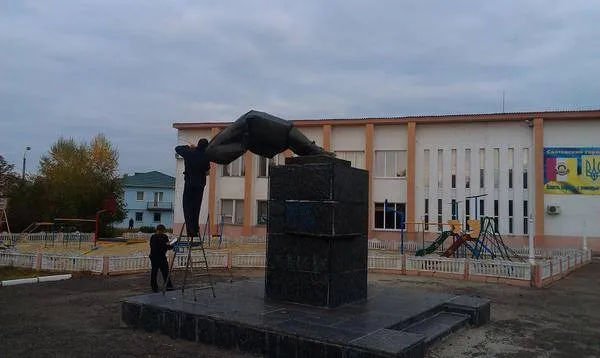
Previously, where the church stood, there was a monument to Lenin, but it was demolished in 2014.
Within one text, it is impossible to delineate all that we, the Ukrainians of Luhansk oblast, lost due to the actions of the communist regime. The destructive nature of Soviet propaganda sought not only to destroy the physical manifestations of the Christian faith but also to delineate the boundaries of self-identification, to destroy it, and to equate the individual's personality with a working mechanism that was supposed to work solely for the construction of a "bright communist future." Similar goals are now pursued by modern Russia – in just two years of full-scale invasion, the occupiers destroyed or damaged:
- The Holy Catherine's Church of the UOC in the city of Schastia;
- The Church of St. Matrona of Moscow in the city of Rubizhne;
- A chapel in honor of the Icon of the Mother of God in Rubizhne;
- The Church in honor of St. Luke of Crimea in Rubizhne;
- The Holy Illyinskyi male monastery in the village of Varvarivka;
- The Christ Nativity Cathedral in the city of Severodonetsk;
- The Church of the Three Holy Hierarchs: Basil the Great, Gregory the Theologian, and John Chrysostom in Popasna;
- The Holy Mitrofanivskyi Church in Lysychansk;
- The churches in honor of St. Tabitha the Righteous of Joppa in the village of Voronove and St. Nicholas in Borivske.