

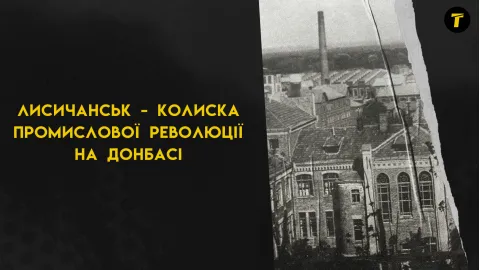
Lysychansk is one of the oldest cities in Donbas. It was the first mining settlement in the Donetsk Basin, where the mining craft originated and developed. Lysychansk has undergone a complex path of development. Like Luhansk, it did not have its own name for a long time. It was called "Selinnya" or "Sloboda of Lysycha Balka." Only around the 1830s did the toponym "Lysychansk" appear in everyday usage.
The history of Lysychansk was told to the TRIBUN publication by local historian and publicist Valeriy Kikhtenko, who also shared interesting facts about the city.
Lysychyi Bayrak on the Donets river
The future city emerged in the 17th century and was initially a wintering settlement called "Lysychyi Bayrak on the Donets” (another name – Lysycha Balka), which was inhabited by Zaporizhian Cossacks. The first part of the name "Lysychyi" originated from the large number of foxes in the Balka.
Why did Lysychyi Bayrak not become a settlement and began to develop as a settlement only after the official start of its coal mining history?
"It can be assumed that the emergence of 'burning stone' scared superstitious Cossacks, who, despite Orthodox faith, still had strong pagan beliefs about unknown forces of nature. Or perhaps, Lysychyi Bayrak was frequently raided by steppe nomads and was not as convenient for temporary residence in a military-defense or territorial-geographical sense as, for example, the wintering settlement 'Vyshcha Bilenka on the Donets,' located near the confluence of the Upper Bilenka. It had better access to the river, and there was an opportunity to quickly load onto mobile boats – 'katorgas' or 'baidaks' – in case of an attack by a large nomadic group and escape to the Bakhmut fortress. Or to lure the enemy to the left floodplain, where it was easier to resist the mounted steppe army among the forests and lakes," says Mr. Valeriy.
The Tatar raiders easily crossed the Donets on horseback but avoided the wooded left bank with swamps and backwaters surrounded by tall reeds, where it was easy to fall into an ambush.
"Moreover, near the wintering settlement of Lysychyi Bayrak, there has long been the Borova ferry, through which large Tatar armed formations periodically moved, threatening sedentary living. Lysychyi Bayrak was more often used by Cossacks as a high point for signal smoke structures with 'khvigur' and wooden towers, through which the 'winterers' exchanged signals about the approach of nomads. As fuel for the signal fires, not only dry brushwood or oil was used but also coal," comments the local historian.
How did the Cossacks defend their borders using "khvigur"?
According to D.I. Yavornitsky's book "History of the Zaporizhian Cossacks," figures (“khvigurs”) were a series of barrels arranged in a certain way and adapted for guard purposes. For each figure, they took 20 identical resin-coated barrels and one completely bottomless one. They arranged them in five rows one after another in the form of a perfect circle. Initially, they placed six barrels in a circle and tied them with resin ropes. Then they placed a second circle of five barrels on them, a third one with four, then a fourth one with three, and a fifth one with two. On top, they placed a barrel without a bottom. Thanks to this arrangement, an empty space was formed inside the figure from top to bottom, into which resin was poured. Above the top barrel, they placed an iron rod with a block, through which a long rope was passed, one end of which was lowered into the cavity of the figure, tying to it an iron wire with a large bunch of mace, soaked in saltpeter, or a tuft of straw.
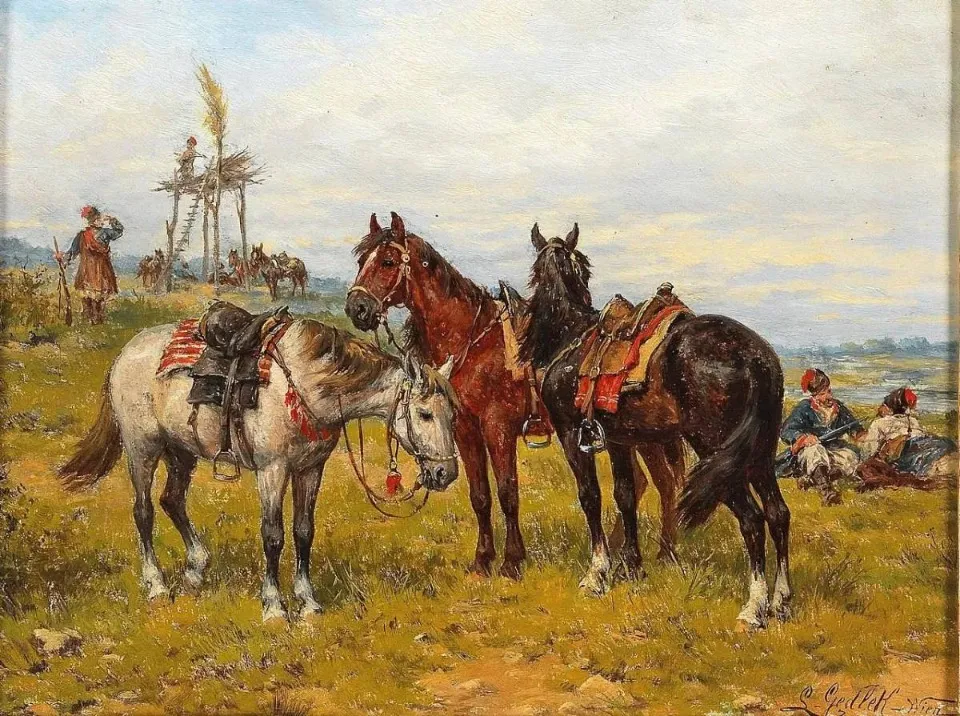
Lysychyi Bayrak did not enter the official annals of history until the appearance of the first Lysychansk mine, and during this period, other neighboring wintering settlements experienced socio-economic development.
In the first half of the 18th century, the wintering settlement Vyshcha Bilenka became the Sloboda Bilenka and part of Sloboda Ukraine – a historical region that included the territory from the Aidar River in Luhansk region to the Bakhmut River in the north of Donetsk region, as well as parts of Zaporizhzhia and Kharkiv regions. Those who wanted to settle in the slobodas were allotted plots, and newcomers started to build settlements.
"It looked like this: first, a pit the size of an ordinary hut was dug out. The sides were lined with layers of turf, onto which rafters were laid, reaching down to the ground. The rafters were covered with grass or reeds, with holes made for windows. Nearby, another pit was dug, and a similar structure was made, connected to the door. These were the hallways, bread storages, or livestock shelters. However, the main part of the grain reserves was kept in a separate pit. Later, these dugouts turned into mud huts, and the bread pits into storerooms. The people who arrived were called 'settlers,' and the land plots were completely at their disposal. This was the initial form of the first state-owned settlements. The arable plots passed from father to son and were called 'homestead.' Covering this period of history, one can conclude that the wintering settlements and settlements of the Zaporizhian Cossacks, as well as the 'zaimanshchyna' of settlers from other regions of Ukraine, became the basis for the emergence of many Ukrainian cities and villages, some of which still exist in Luhansk region today," Kikhtenko explains.
In today’s Lysychansk, there are many families with surnames such as Levchenko, Chornyi, Porokhnia, Magro, Harkusha, Chereda, Chaliy, Zabirko, Berehovyi, Boyko, Honchar, Zhurba, Zasukha, Zasiadko, Zakharchenko, Ivanenko, Kushchii, Kovalenko, Lanovyi, Lysenko, Maloi, Oliinyk, Petrenko, Shcherbina, Yakymenko, Rud, Didenko, Zamula, Holovko, Nis, Kravets, Tovmach, Reshetilo, Samarskyi, Karas, Bilous, Taran, Lytvynenko, Rudyi, Tkach, Riadno, Muzika, Lykhosherst.
"These are traditionally 'Zaporizhzhian' surnames, and the residents of our city can rightfully take pride in their genealogical connection to the 'Sich Cossacks' in a way. Our ancestors were right when they said, 'There is no end for the Cossack kin'," adds the publicist.
Referring to the book "History of the Native Land" by A. Gorelik, G. Namdarov, V. Bashkina, Luhansk, 1997, we learn that by the end of the 18th century, in the Verkhnye, which would later become part of Lysychansk, there were 94 homesteads and about 1000 residents. By this time, a coal mine was already operating on the territory of Lysyachyi Bayrak, but the peasants were initially reluctant to join the ranks of miners, enjoying all the benefits of a rich natural area. The Siverskyi Donets River was full of fish, and the coastal forests teemed with game – hares, partridges, wild geese, ducks, and roe deer. The inhabitants of the Verkhnye engaged in farming and animal husbandry, spun flax and wool, wove linen and cloth. Surpluses were sold at the local market and fair, which was held in the area of present-day Stanitsa Luhanska, on the left bank of the Donets. People then lived in oak or willow houses, under a straw-reed roof. Clay and chalk were also used in the construction of such dwellings. Behind the entrance doors were halls with household belongings. The most spacious room usually had a table surrounded by benches, icons adorned with towels, and a large stove. In the courtyard buildings, there was a workshop where men carpentered, and women prepared hemp for spinning in the autumn. Nearby, they built a pen for livestock. Agricultural tools, grain, firewood, and manure were usually stored in separate buildings called "komora." Depending on the income level, there could be stables and poultry houses in the yards. The arrangement of household life reflected not only economic features but also the customs and beliefs of Ukrainian peasants at the end of the 18th century.
First soda in the Donbass region
Later on, foreign capitalists poured into Donbas, including Lysychansk. One such example is the establishment of the Donetsk Soda Plant "Donsoda" by the Russian-Belgian joint-stock company "Lyubimov, Solve & Co."
"Despite Lysychansk becoming the pioneer of industrial coal mining for Ukrainian and Russian territories at the time, the greatest impetus for the city's socio-economic development came from another industrial sphere. In 1892, an event took place in the city's history that became the engine of industrial and cultural development for the entire region for many years. Belgian industrialist and chemist Ernest Solvay, along with Perm merchant Ivan Lyubimov, built a soda plant that soon became one of the leading enterprises in Europe."
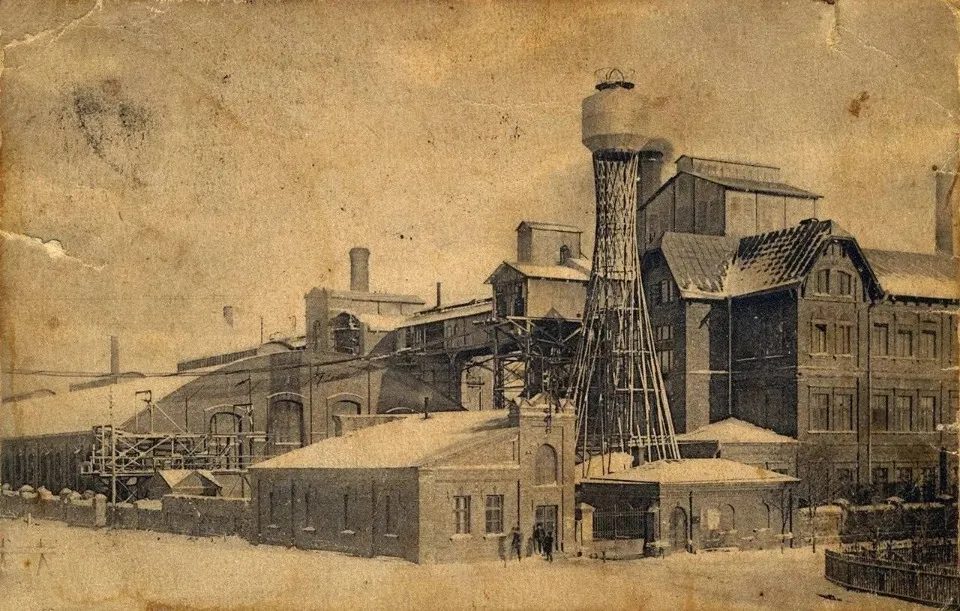
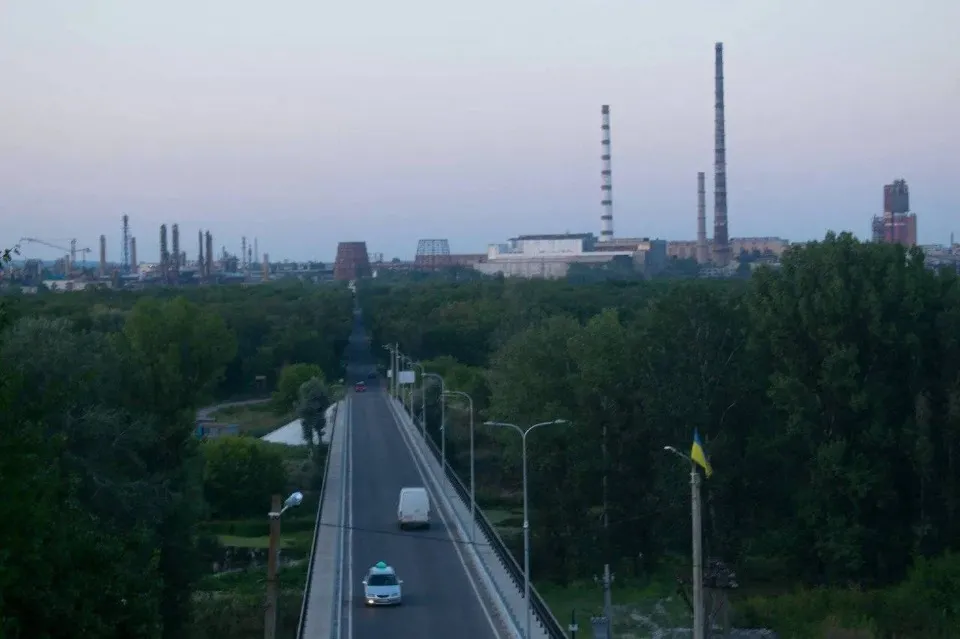
At the end of April 1892, the plant started working. Production of calcined soda by the ammonia method began. In November of the same year, the caustic soda workshop, which produced soda by the Ferite method, was put into operation. The daily production of calcined soda in 1898 reached 200 tons, which amounted to 70,000 tons per year. The plant also produced caustic soda - sodium bicarbonate, lime chloride, rubbing alcohol. The plant was named Donetsk after the river it stood on. Under this name, the plant operated for three-quarters of a century, after which it was renamed Lysychansk.
"At the end of the 19th century, it employed over 900 permanent workers, and in 1916 - 1554 people. To supply the plant with fuel, the joint-stock company leased the "Dagmara" mine, and in 1896, they built the "Konstantin Skalkovsky" mine. In 1902, 6.8 million poods of coal were mined there, and the number of workers exceeded 900 people. Coal transportation was carried out in wagons using the famous cable-suspended railway, which is the longest in Europe. For the extraction of chalk, the plant hired upper villagers and opened a chalk quarry. Chalk was extracted manually, except for explosive work. Delivery by cable was quite cheap for the plant, unlike salt transportation - the most important component for soda production. The salt, mined near Bakhmut, was transported by barges to the Deconska railway station, and from there by train to the plant, where it was crushed and sent for production. Extraction, transportation, and dissolution required significant costs. It was much cheaper to dissolve the salt in the ground and pump the ready concentrate to the plant. For this purpose, in 1912, a brine plant was built with pumping stations and reinforced concrete reservoirs, which became one of the largest in Europe. The first line of electric transmission at 20,000 volts, 35 kilometers long, was installed for the pumping electric motors, the first of its kind in the Donbas. The Lysychansk land had never seen such technological structures. This type of enterprise was the first in the Donbas and the second in Europe. And soon, Ernest Solvay became one of the richest and most influential people in the world," explains local historian Valeriy Kikhtenko.
The construction of such a large chemical plant was a significant socio-economic factor in the further development of the entire Lysychansk region. Hundreds of landless peasants and unemployed individuals from surrounding areas, as well as nearby Ukrainian lands and Russian provinces, found employment and housing here, starting families. The engineering and labor potential of the workers at the soda plant became the basis for the development of cultural life.
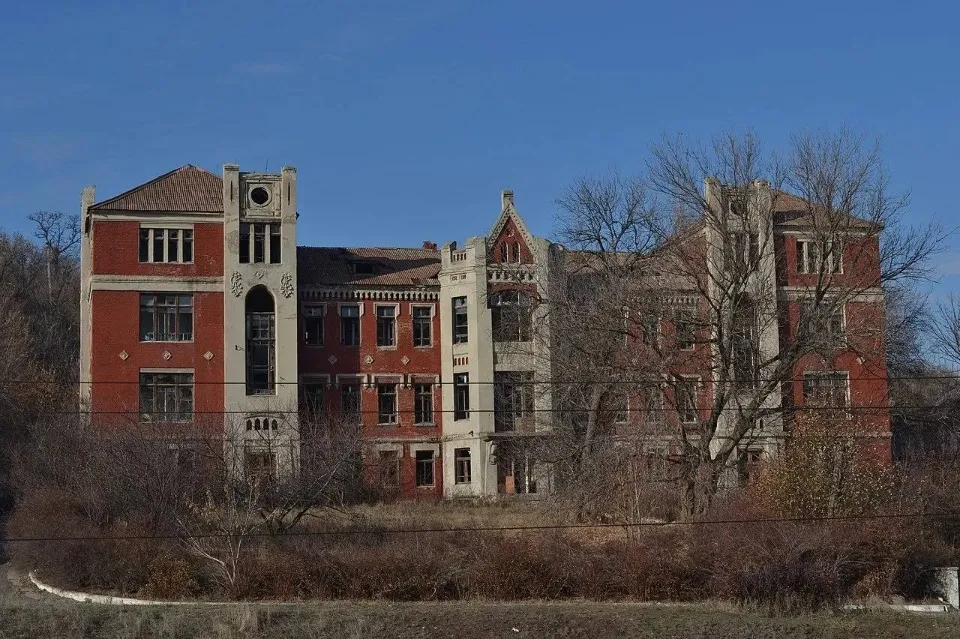
"The owners of the soda plant generously invested in Lysychansk's infrastructure. One of the best clinics in Donbas operated under the enterprise, and a network of primary educational institutions emerged. Around the soda plant, an organized neighborhood in the 'modern' style emerged, featuring a school, theater, stadium, and recreational park. Additionally, the establishment of large-scale soda production led to an influx of job opportunities and foreign capital, leading to the construction of a glass factory and other affiliated enterprises in Lysychansk. The city saw the rise of an elite class with European education and high moral values. The majority of Lysychansk residents adhered to the Orthodox faith, thus avoiding religious conflicts in the city. However, in 1917, Lysychansk's European path was interrupted," says Kikhtenko.
Interesting Stories from Lysychansk from Valeriy Kikhtenko's book "Unknown Lysychansk".
Where Tomatoes Came From to Lysychansk
One spring day in 1915, a notable event occurred in the house of Lysychansk entrepreneur Tikhon Azhippo. Tikhon had contracts at the salt mines of Bahmut and often brought gifts from the local market for his wife Yefrosinia and sons Ivan and Oleksiy. However, this time he only brought small balls with seeds.
"This is the seed of 'love apples,' or as we call them, tomatoes," Tikhon informed his wife. "They grow outdoors from midsummer to frost. You should eat them like cucumbers, with vinegar and pepper. I've tried them, they're quite good."
Following her husband's advice, Yefrosinia filled a box with soil mixed with raw sand in equal proportions, sowed the seeds, and placed it in the cold cellar. She then transplanted the seedlings that appeared into the garden.
... One day, Tikhon was delayed in Bahmut for a long time, and when he returned, he saw several bushes with red vegetables in the garden.
"Why aren't you eating the tomatoes?" he asked his family, surprised.
"We don't know how to approach them," his wife replied.
"People say these 'love apples' of yours remind wolf berries..."
Tikhon smiled, plucked a tomato, and split it in half. He heavily salted one half and ate it. He handed the other half to Yefrosinia. The woman cautiously took a bite and immediately spat it out, wrinkling her nose: "...not tasty..."
But the following spring, "love apples" appeared not only in the Azhippo family's garden but also in neighboring plots.
And that's how tomatoes appeared in Lysychansk.
Why Upper (Verkhne) Was Not Renamed Voroshilovsk
In the early years after the civil war, Lysychansk and Verkhne went through difficult times. More than half of the mines were flooded, and the soda plant practically stopped working. Lysychansk was plagued by robberies, homeless people formed gangs, and in surrounding villages, peasants resisted requisitioning. In addition, the new authorities were actively opposed by the "Soldiers' Organization," created at the soda plant and the "Kostyantyn Skalkovsky" mine. It consisted of soldiers who had returned from the fronts of World War I and was supported financially by Lysychansk industrialists and entrepreneurs, from whom the Bolsheviks had taken over factories and coal enterprises. In January 1918, the "Soldiers' Organization" attacked the Lysychansk Revkom, but the uprising was suppressed with the help of Red Guards. In March, soldiers from the "organization" disarmed a Red Guard unit at the soda plant, and in April, they fired at a train carrying Red Army soldiers at the Pereizna railway station. In the winter of 1920, Kliment Voroshilov (at that time a member of the Revvyy Council) traveled by train from Lysychansk to the Pereizna station to meet with the temporary commander of the Verkhne village. In the area of the current "stekolnyanskoho" crossing, the train was fired upon by bandits, and Voroshilov miraculously escaped death.
Large gangs even attacked settlements, killing party and Soviet activists. At dawn, on August 21, 1920, a gang of about 200 people attacked Verkhnye. However, the fighters of the guard unit, organized by local communists, managed to repel the attack. By 1922, with the active participation of the population, banditry in Lysychansk and its outskirts had been eliminated. Years later, when Lysychansk communists appealed to Voroshilov to immortalize his name in the city's name – renaming Verkhnye to Voroshilovsk, the "first red commander" decisively refused, arguing that "the places there are too bandit-infested."
Monk-Martyr
A mystical story is associated with the Church of St. John the Baptist, which was built almost 100 years before the Mitrofanovska Church and was located where the Palace of Culture is now situated (in the area of Chervona Street). The priest there was a hieromonk named Father Hennadiy.
In 1918, when the Soviet authorities declared the clergy outlawed, employees of the district NKVD led by an investigator named Mamontiv broke into the Church of St. John the Baptist. They burned icons, stabbed the altar with bayonets, and crucified the hieromonk himself on the cross because he did not renounce his faith, under Mamontiv's orders.
Before his death, Father Hennadiy cursed his torturers with punishment in the form of fire and thunder. Some time later, a mobile cinema was brought to the church, and a sign was hung saying "ATHEIST CINEMA." During the first movie screening, lightning struck the church, and a fire broke out. The wooden church burned down in a matter of minutes. However, all the viewers miraculously survived, except for Mamontiv himself, who also came to the cinema.
For a whole year, people avoided this place, where every night an owl hooted, and grass refused to grow. And Father Hennadiy was counted among the great martyrs.