

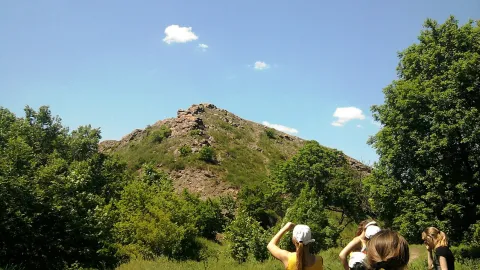
The Royal Cliffs, located in the Dovzhan’sky district (southern part of Luhansk region) near the Russian border, hold a special place among the region’s noteworthy natural attractions. Its appearance contradicts the widespread assumption that the Luhansk region is predominantly a steppe. A large part of the southern area of the region is covered by a series of small cliffs—the Donets Ridge. These elevations, which are geological outcrops of sandstone, create a picturesque landscape that combines mountain scenery, steppe vastness, groves, and striking emerald green forests.
In this article for “TRIBUN”, historian Oleksandr Naboka speaks about the history of the Royal Cliffs and their difficult and even unrealistic "Zhadanian" present, as discussed in this article.
The Royal Cliffs are a notable, but not unique, geological landmark. As our expert, one of the leading botanists of Luhansk region, Mykyta Peregrym, noted:
"Uniqueness-wise, there is nothing special about the Royal Cliffs. These are typical sandstone outcrops that are characteristic of the Donets Ridge. Perhaps they attract more attention because they have a very high amplitude between the foot and the top, where there is a fairly high height difference. The same difference can be found within the ridge, but only in 2 or 3 places."
Sandstone is a sedimentary geological rock. Its high concentration in the south of the Luhansk region leads to the creation of numerous outcrops. Local residents have been using sandstone as a building material for centuries. The vast majority of houses in the settlements located on the Donets Ridge are made of it. Before the start of hostilities in 2014, as Mykyta Peregrym noted, processed slabs of flat sandstone were sold even to Moscow for cladding houses.
As a result, over the past hundred years, many beautiful sandstone outcrops have been transformed into quarries for their extraction. Apparently, the same fate could have awaited the Royal Cliffs, with their rich deposits of material lying literally on the surface. However, it was saved by the status of a nature reserve area that was granted in the 1970s.
Thus, it was possible to save not only the gorgeous landscape but also the local, diverse ecosystem. The site is known for the scientifically important plant species that grow here. In particular, the following plants are listed in the Red Book of Ukraine: Allium lineare (a type of wild onion), Asplenium septentrionale (northern or forked spleenwort), and many others.
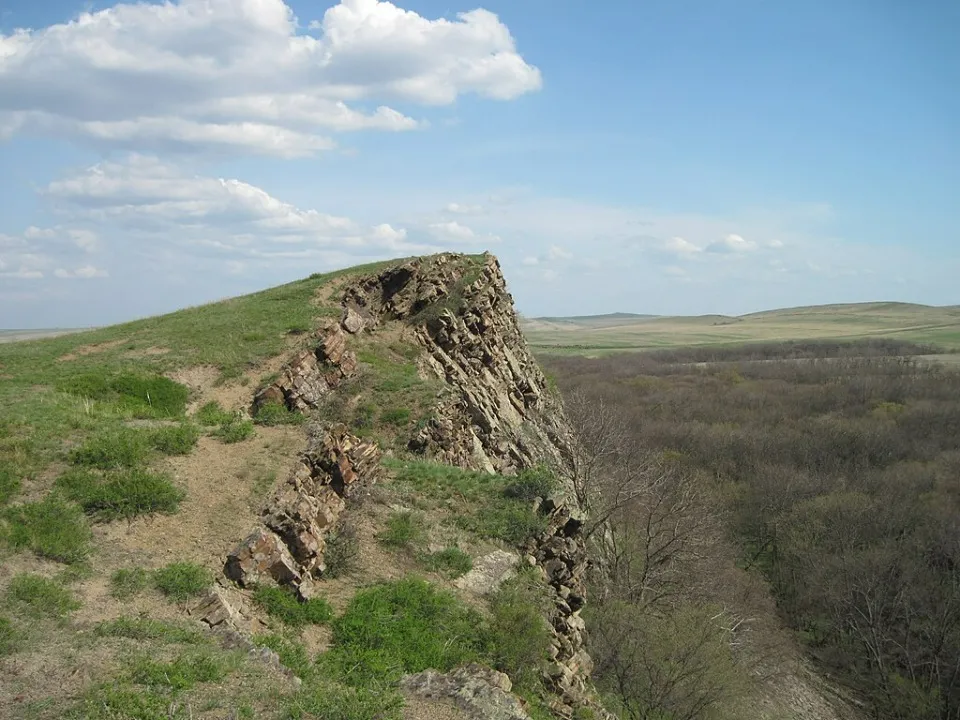
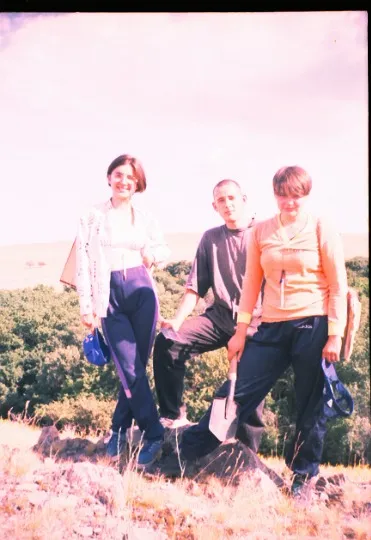
Thanks to this, the Royal Cliffs have become a venue for numerous scientific expeditions and internships for future biologists and geographers. It was here that students of Luhansk colleges and universities, primarily future natural history teachers, experienced living in tents and playing the guitar together around a nightly campfire. Mykyta Peregrym, who studied the local flora as part of his PhD research, has visited the area many times in different seasons.
However, it should be noted that one of the main potential "tourist pearls" of the Luhansk region never became one due to constant local issues that have been forming almost since the declaration of Ukrainian independence.
The Royal Cliffs remained known only to a small group of researchers, mainly due to the narrow-mindedness of regional leaders—they did not imagine tourism as an industry that could generate profits similar to the mining industry. Almost no one was engaged in the popularization of this natural attraction.
As a result, very little is known about it. It is not even possible to say for sure how its name came about. The historical social consciousness of many Luhansk region residents, distorted by years of imperial influence, traditionally associated it with the “queen”, the Russian empress Catherine II. The myth that she traveled around Luhansk region, naming rivers, settlements, and natural monuments left and right, was repeatedly heard by the author of these lines throughout his travels.
However, the Catherine II myth often turns out to be a historical fake. The "royal" title does not equal the higher "imperial" title. Those who associate the name of the Royal Cliffs with Catherine II are rather degrading the dignity of their favorite imperial idol.
Mykyta Peregrym heard another legend from the locals. They say that once there was a local manager whose surname was «Karalyov». One day, he got drunk and mistakenly drove his cart into a rocky abyss. Due to these events, the surrounding villagers began to call the area «Karalyovsky». When the first students started coming here, they changed the name to a more romantic, "royal" name.
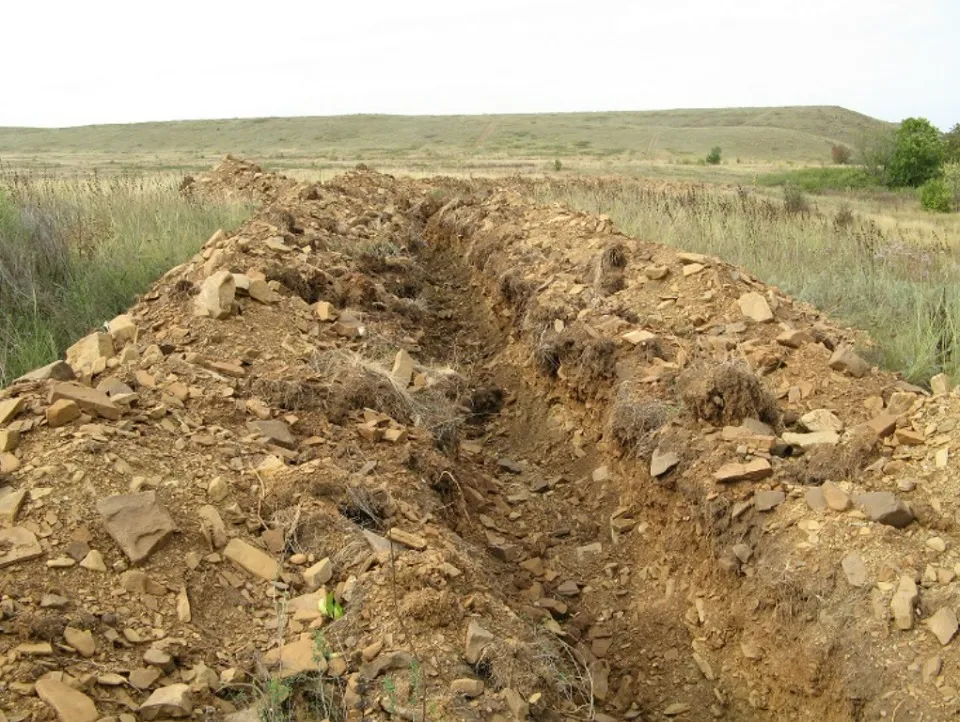
He noted that at the turn of the XX and XXI centuries, illegal routes for smuggling fuel from Russia were organized nearby, so special promotion of the site was probably simply unprofitable. Students and researchers were simply advised to "ignore" the quite frequent fuel trucks that traveled back and forth across the dusty steppe paths through the transparent, pre-war Russian-Ukrainian border. Although the SBU (Служба безпеки України - Security Service of Ukraine) occasionally dug up these smuggling routes, it did not bring systemic results.
The criminal "transparency" of the Russian-Ukrainian border in the area led to the formation of a metaphysical atmosphere of Zhadan's "Voroshylovhrad", in which time froze and the times of the medieval "Wild Field" seemed to return. Our expert (Perehrym) noted that one could meet real nomads here who, like their ancestors, came to these lands from the Caucasus with numerous flocks of sheep, ignoring the "political" borders.
Indeed, since the Bronze Age, the area around the Royal Cliffs has been an area of nomadic peoples. According to Serhii Telizhenko, one of the leading Luhansk region archaeologists, the area around the Royal Cliffs was full of nomadic life in ancient times and in the early Middle Ages, as evidenced by the remains of their settlements and burial mounds.
"There were definitely burials there (at the Royal Cliffs - O. N.). They are located on a hill, and the settlements are below... There is a convenient place, a river, and open spaces where you can graze cattle. And there's a place to bury your family. The burials were not only from the Bronze Age, but also,it seems, of late nomads," - the scholar noted.
Centuries passed, but life remained largely the same as in ancient times. The nomadic lifestyle of the ancestors was picked up by their descendants. According to Mykyta Peregrym, the local pastures were used for sheep grazing by the Dargins, the second largest ethnic group in Dagestan, who have been bringing numerous herds of cattle here for centuries, miraculously bypassing modern political borders. At the same time, the sheep ate the local grass completely. Mykyta Peregrym was amazed that the sheep were able to get green sprouts even in narrow gorges.
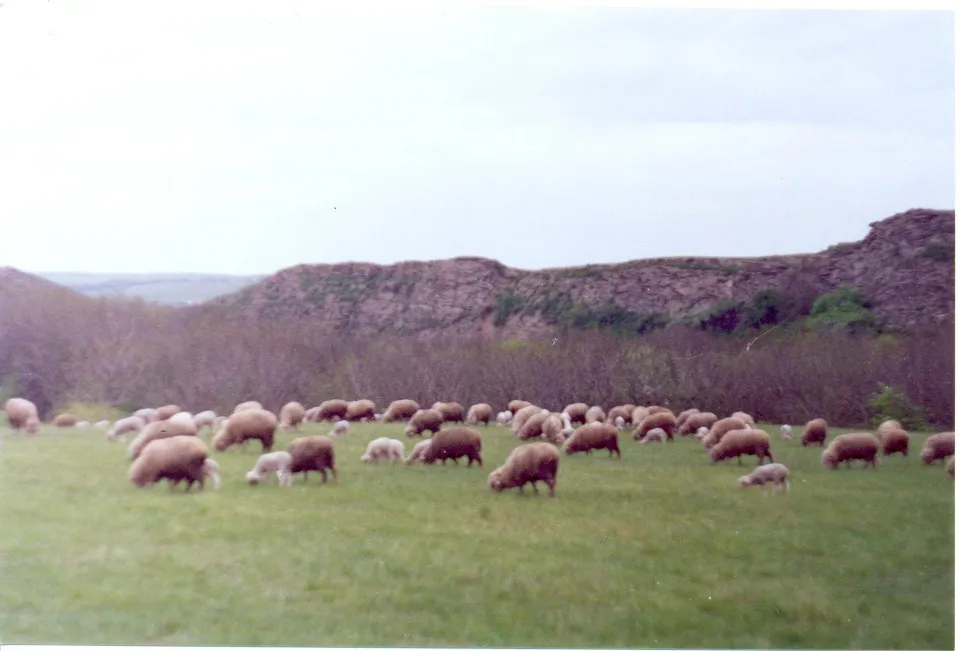
According to our expert, such predatory use of the local flora has led to the almost complete disappearance of some unique plants.
"We can state that the population of Asplenium trichomanes (hairy spleenwort) has disappeared in the geological natural monument, the Royal Cliffs, near the village of Provallia, Sverdlovsk district, Luhansk region. The main reason for this loss is undoubtedly the unceremonious grazing of sheep and goats," noted Mykyta Peregrym.
So, the Royal Cliffs are the place where history stopped. This is an enclave of the historical and metaphysical "Wild Field" of the "Barbarian Frontier" that has survived to this day, despite the civilizing pathos of the Russian and homegrown emperors. The conservation of time, its cyclical nature, is the result of the preservation of the old, "savage" laws of existence, which have been transformed into the criminal, fraudulent schemes of our time. Perhaps this is the main reason why Luhansk, despite its potential, has not yet turned into a region with a developed tourist infrastructure.