
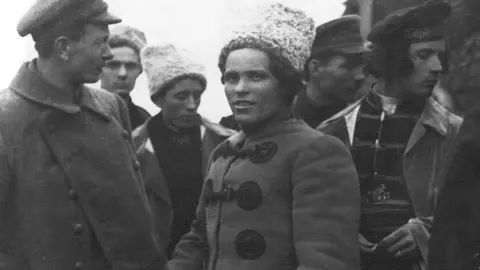
The events of the 1917-1921 Ukrainian Revolution , or as it is commonly called, the first Ukrainian War of Independence, left their mark on the history of the Luhansk region. They were mainly military and political in nature: the emergence of county councils, the formation of the Free Cossacks, the battles of General Volodymyr Sikevych's Slavic Group for the liberation of our region from the Bolsheviks, and the activities of atamans in our region, including Nestor Makhno.
In an article for “TRIBUN”, historian Valeriy Negmatov analyzed the trace of the 1917-1921 Ukrainian Revolution in the history of Luhansk region.
Background information: Valeriy Negmatov is a historian from the city of Sievierodonetsk, specializing in historical memory, and as a local historian he has been studying his native region for his entire life.
The emergence of the Free Cossacks in Luhansk region
Immediately after the outbreak of the Ukrainian Revolution, branches of Ukrainian political parties and public organizations began to emerge in Luhansk region, which was part of the Donetsk district. In the spring and summer of 1917, the Central Rada created its own county councils in our region, which relied on Ukrainianized military units and Free Cossacks. The Free Cossacks were voluntary military formations in Ukraine and the Kuban region in 1917-1918 that were created on a territorial basis, based on the traditions of the Zaporizhzhya Cossacks, mainly to protect law and order. Until the fall of 1917, they consisted mainly of peasants.The Ukrainian Revolution had its supporters on the lands that once belonged to the Zaporizhzhia and Sloboda Cossacks. The Bolsheviks tried to create Red Guard units as a counterweight to the Free Cossacks, but their efforts found supporters only in cities, but not in all of them.
Formation of the Zaporizhzhya Corps
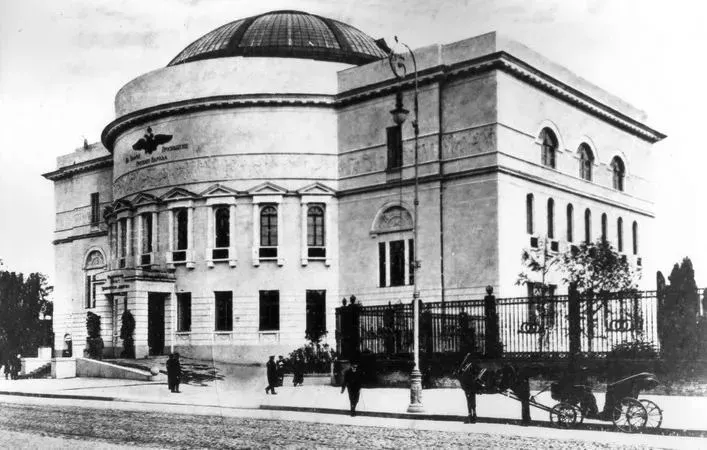
The Ukrainian Central Rada (UCR) lost the Luhansk region as a result of the first Soviet-Ukrainian war (December 1917-March 1918). After the conclusion of the Brest Peace on February 9, 1918, with the countries of the Quaternary Alliance, the UCR had a chance to liberate the lost lands from the Bolsheviks. On March 2, 1918, Ukrainian troops liberated Kyiv from the Bolsheviks. The Central Rada and other authorities and institutions of the Ukrainian People's Republic returned to the capital. The armed forces were reorganized there. A separate Zaporizhzhia detachment was expanded into a brigade, and later into the Zaporizhzhia Division under the command of General Oleksandr Natiev.
In early April 1918, it was reorganized into a corps. It consisted of: The 1st Zaporizhzhia Regiment of Mounted Haidamaks named after Koshovyi Kostiantyn Hordiienko (Vsevolod Petriv), the 1st Zaporizhzhia Infantry Regiment named after Hetman P. Doroshenko (Oleksandr Zahrodskyi), the 2nd Zaporizhzhia Infantry Regiment (Petro Bolbochan), the 3rd Zaporizhzhia Infantry Regiment named after Hetman B. Khmelnytskyi (Oleksandr Shapoval), 3rd Haidamak Infantry Regiment (Volodymyr Sikevych), 1st Zaporizhzhia Artillery Regiment (Viacheslav Parfeniv and Semen Loshchenko), 1st Zaporizhzhia Engineer Regiment (Oleksandr Kozma), Zaporizhzhia Mounted Artillery Division (Oleksa Almazov), 1st Ukrainian (Zaporizhzhia) Aviation Detachment (M. Baraniv) and the 1st Zaporizhzhia Auto-Panzer Division (Oleksandr Boldyriv).
Battles for the Ukrainian Luhansk and Donetsk regions
On April 10, 1918, the Ukrainian People's Republic Minister of War Oleksandr Zhukovskyi secretly ordered the commander of the Zaporizhzhya Division, General Oleksandr Natiev, to form the Crimean Group, which was to outrun German troops, occupy the peninsula, and establish control over the Black Sea Fleet. The task of the group of General Volodymyr Sikevych, the battalion commander of the Ukrainian People's Republic, which was called the Slavic Group, was to liberate Eastern Ukraine and establish control over the resources of the Donetsk coal basin. The Sloviansk group included the 1st Zaporizhzhia Infantry Regiment named after Petro Doroshenko (O. Zagrodskyi), the 3rd Zaporizhzhia Infantry Regiment named after Bohdan Khmelnytskyi (O. Shapoval), the 3rd Haidamak Regiment and some other units.
On April 15, 1918, after an intense 12-hour battle, the Slavic Group took the station of Barvinkove in the Kharkiv region. On April 17, the Bohdanivtsi entered Sloviansk, and the next day the Cossacks liberated Bakhmut. The workers' delegation from Kramatorsk met the Slavic group soldiers and presented the Ukrainian soldiers with a flag with the inscription "Let this flag be a blessing to the workers in the struggle for an independent, united Ukraine. We are with you!" On April 25-27, the Cossacks and Germans fought heavy battles with the Bolsheviks near Horlivka and its outskirts, including the Mykytivka station and the Mercury Plant.
The Slavic Group's offensive continued in three directions: to Yuzivka station (now Donetsk), Popasna, and Debaltseve. The Bohdanivka regiment captured Debaltseve in the battle on April 28, after which they moved to Kolpakovo station (now the village of Kovpakove, Antratsyt district, Luhansk region), which was located on the administrative border of the Yekaterinoslav province and the Don Army region.
On April 30, Bohdanivka soldiers arrived in Kolpakove. At that time, an anti-Bolshevik Cossack uprising was unfolding in the Don, which ended in early May 1918 with the overthrow of Soviet rule and the establishment of Ataman Petro Krasnov's rule. The Ukrainian government sought to establish friendly relations with the Don, and therefore V. Sikevych was ordered to stop the advance of the Slavic Group, allowing the Germans to move further east.
The liberation of Donbas by the Cossacks ended with a symbolic act: in Kolpakove, the Cossacks brought two tall poles they had found at the station, painted them yellow and blue, and on each of the two sides they drew a trident with the words "UPR" written underneath. Holders for Ukrainian flags were nailed to the poles. The priest served a prayer service and sprinkled the flags with holy water. The Cossacks set up the poles to solemn music and cannon salutes, and the soldiers present shouted: "Glory!".
Protection of Ukrainian borders in 1918
After the end of the military operation, the Cossacks performed garrison service in Bakhmut, Sloviansk, Mykytivka, Debaltseve, and Kramatorsk. V. Sikevych's headquarters was located in Mykytivka. On the orders of General Natiev, the soldiers of the Sloviansk group guarded state property in Donbas and helped restore the decaying coal industry. The division served on the border until the anti-Hetman uprising in November 1918.
Known and unknown heroes
Semen Loshchenko was born in the village of Ivanivka (now Antratsytskyi district, Luhansk region). In the spring of 1917, he was among the first ten officers to join the first Ukrainian regiment named after Bohdan Khmelnytsky, the commander of Ukrainian artillery at the legendary Kruty. He was the youngest combat brigade commander of the UPR Army. He died and was buried in Germany, near Nuremberg, in 1980. He is the author of a seminal memoir about the battle of Kruty, which has not yet been published in Ukraine or introduced into scientific circulation. There is still no artillery brigade named after S. Loshchenko in Ukraine, not even a small street or alley.
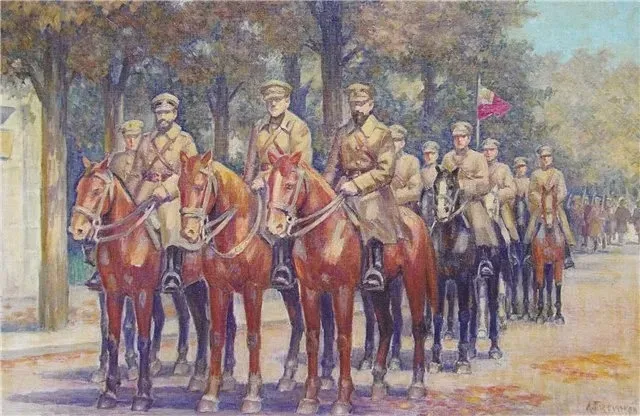
Soldiers of the Lyakhovych Cavalry in Hordiienko Regiment of the Ukrainian People's Republic Army
In the village of Mozhniakivka, Novopskov district, there is an unmarked burial of soldiers of the horse-drawn hundred of the Lyakhovych Cavalry Regiment in the Hordiienko Cavalry Regiment of the UPR Army. The regiment, as part of V. Sikevych's group, liberated the Luhansk region from the Bolsheviks, and later defended the state border of the UPR - the Ukrainian State.
“Otamanshсhyna” in Luhansk region
“Otamanshсhyna”, a term coined by V. Vynnychenko, refers to the presence of a large number of guerrilla units in a certain territory headed by their otamans, who actually had military and political power in the face of the insufficient power of the Directory's state authorities.
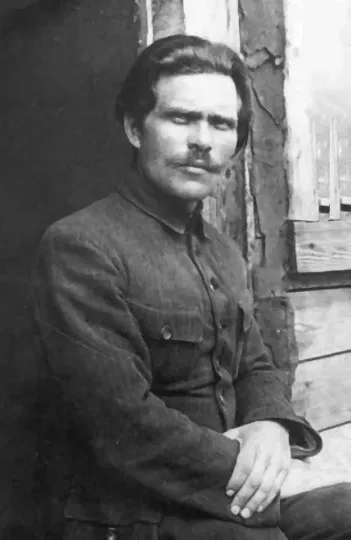
In Luhansk region, most atamans were either sent there by N. Makhno or had anarchist views. For example: Kamenev's group (Kameniuky), Cheredniak's group, who were tasked with destroying the White Guard's rear in Bakhmut, Izyum, Starobilsk, and Kharkiv districts.
Makhno himself was in Starobilsk in the fall of 1920 for medical treatment, where, incidentally, he signed an agreement with the Bolsheviks on a joint struggle against Wrangel's White Guards, which later led to the defeat of the Makhno movement.