

Today situation once again proves that it is necessary to speak Ukrainian. Many people might find it difficult to start speak Ukrainian, but it is necessary to do. First of all, our interlocutors identify us by our language, it also distinguishes us from Russians.
For almost its entire history, Russia has been "instilling" Ukrainians with inferiority syndrome by creating manipulations and fakes in the political, spiritual, cultural, and historical spheres of life. Unfortunately, this process applies to the linguistic sphere as well.
Today we need to establish certain borders, including the language one.It is necessary to popularize Ukrainian so that speaking this language is considered to be fashionable.
This article is devoted to some fakes about the Ukrainian language spread by Russian propaganda.
Fake 1: The Russian language is closest to Ukrainian
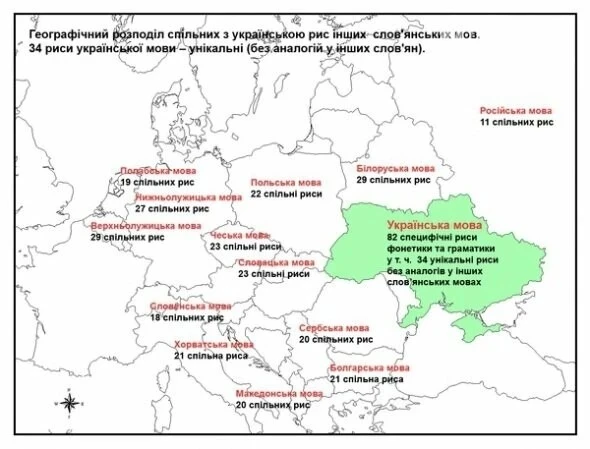
This myth has been existing for many years.However, in terms of vocabulary, the closest to the Ukrainian language is Belarusian (84% of the common vocabulary), Polish (70%), Slovak (68%) and Russian (62%)- in fourth place.
Professor of the O. Potebna Institute of Linguistics of the National Academy of Sciences of Ukraine Hryhorii Pivtorak writes in his work:
"Linguistic contacts of the Ukrainian and Belarusian languages began during the period of Kyivan Rus on the basis of close relations of proto-Belarusian tribes with the glades and Kyiv.Even more favorable conditions for such contacts were created in the 14th - 17th centuries, when the Ukrainian-Belarusian-Lithuanian state emerged - the Grand Duchy of Lithuania, in which the state literary and written language was the Western Russian written language (a common Ukrainian-Belarusian language)."
Kostiantyn Tyshchenko, a professor at Taras Shevchenko Kyiv National University, once created a map of the linguistic proximity of European languages, including Slavic, in particular, and East Slavic.According to his map of lexical distances, it is clear that between the Ukrainian and Belarusian languages this "distance" is 16% of differences, while Ukrainian differs from Russian by 38%
Fake 2: Residents of the southern and eastern parts of Ukraine have always spoken Russian
The active period of total reification in the 1930s brought the most sad consequences for the left-bank Ukraine, because even before that it was under the rule of the Russian Empire.Currently, the language is being cleaned of unnecessary Russianisms and "lost" vocabulary is being returned to the language.
Fake 3: Ukrainian is spoken only in the western part of Ukraine According to the results of a survey conducted in February
2022 by the Razumkov Center, in all regions of Ukraine the language of everyday communication for 56% of the population is Ukrainian, for 23% - Russian, for 21% - both languages equally.67.7% of the population named Ukrainian as their native language.
Fake 4: Ukrainian is the result of transformations of other languages
The Russians have a special hatred for us, because the history of the formation of our ethnic groups and languages shows that Ukrainians are an older nation.The Ukrainian language is an independent language that originates from Proto-Slavic.It belongs to the East Slavic subgroup of Slavic languages, like Russian and Belarusian.The formation of Slavic languages is different, but the Russians, trying to ascribe to themselves a history that is not their own, decided to declare themselves the first and the best,took many Ukrainian written monuments to Moscow at different times, informed everyone that this was their heritage.The fact that Russians love to steal, we known even today.They skillfully and shamelessly steal everything:from icons and chronicles to factories, washing machines and underwear.Of course, they steal territories, try to destroy the owner.
Fake 5. There are "language inspectors" on Ukrainian streets
Propaganda still spreads the horror story about "language inspectors" who control that Russian is not heard in public space.
The law on language does not provide for the introduction of "language inspectors".Even if there were inspectors, they should not walk the streets and listen to see if people speak Russian.It was assumed that inspectors should respond to citizens' complaints about violation of their rights to services in Ukrainian.
Fake 6: Ukrainians demand to make Ukrainian the second official language in Poland
"While the Poles dreamed of reunification with Western Ukraine, they seem to have slept through a new danger, Komsomolskaya Pravda "warns".
"Refugees from Ukraine demanded to recognize their language official in Poland and angered local residents," - NewInform writes.
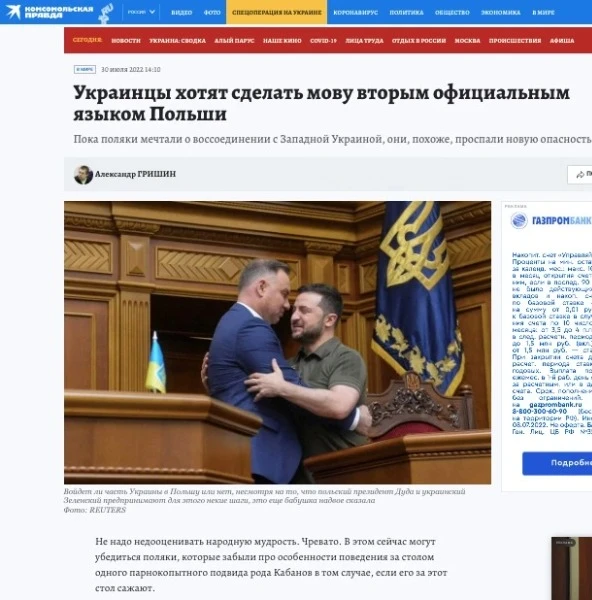
It all started when an article appeared on the website Wyborcza.pl with the title "Almost every third resident of Wroclaw is Ukrainian. And there are more and more of them."
The material referred to a study by the Union of Polish Metropolies, which showed that Wrocław is the second Polish city after Warsaw in which the largest number of Ukrainians live.Analysts' data also showed that the number of Ukrainians is increasing, and they most often choose large cities to live in Poland.The experts also emphasized that "the dynamics of changes in the size of the population of Ukraine in terms of space largely correspond to expectations."
Ukrainian activist Ihor Isayev gave his reaction to the article.He wrote on his Facebook page that "the law on national minorities allows the introduction of an auxiliary language (as well as bilingual signs) in the commune if there are at least 20% of minority representatives.There is no interpretation of what is the case with emigrants, although the law does not explicitly mention this.
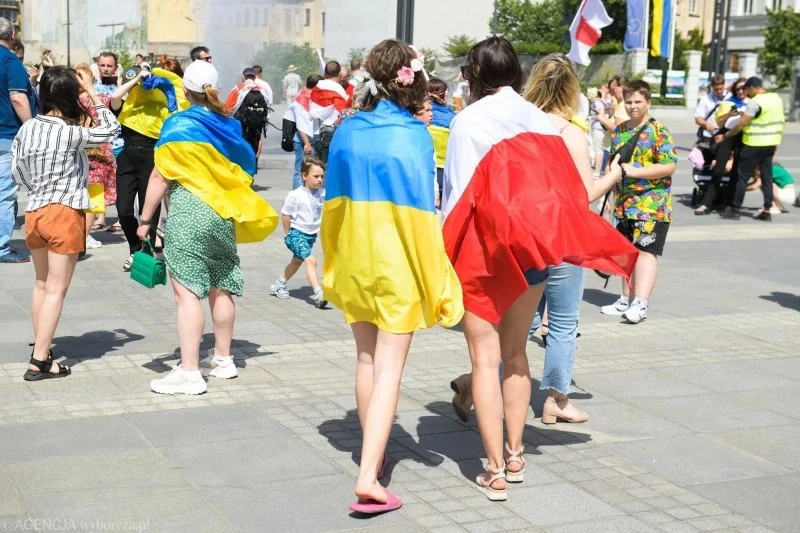
In fact, Ukrainian refugees did not make such demands.The Constitution of Poland clearly states that the only official language in the country is Polish, and it is spoken by the majority of people living in the republic.Minorities have the opportunity to use their language as an auxiliary language, if their number is not less than 20% of the total number of inhabitants of a particular commune, and they must be entered in the Official Register of communes where the auxiliary language is used. Today the Ukrainian language does not have such a status in any of the communes.
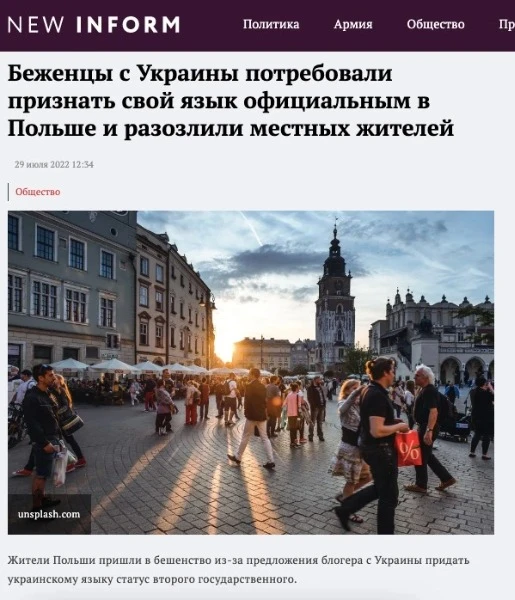
There is also a Law on National and Ethnic Minorities and a Law on Regional Languages in Poland. According to the document, Ukrainians are considered a national minority, have the right to use the language of their minority both in private and public life, to disseminate and exchange information in the language of the minority, to post information of a private nature, to study and learn their language, etc.
Fake 7. Non-existent Ukrainian words
Fake words: spalakhuika (lighter), interfloor drotokhid (elevator), peredrynkuvach (gear lever), rubber natsiuisrnyk (condom), shtrykalnyk (nurse), rozchepirka (umbrella), etc. is not found in any official dictionary.The Russians ese and many other word combinations made up for laughs.
You can usually read them in Ukrainian-hating publications.
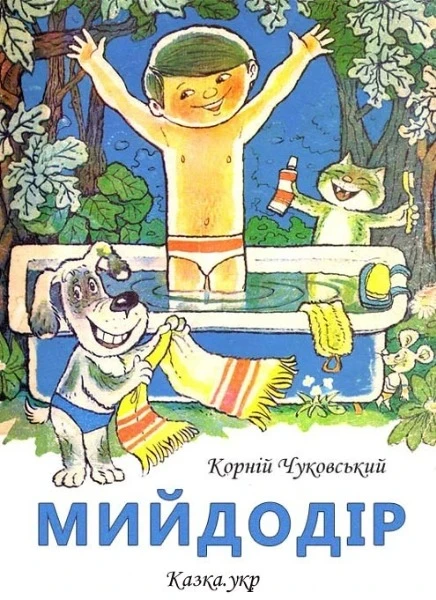
Many of these posts were spread on the network on the occasion of the Day of Ukrainian Literature and Language. The Russians also use humorous Ukrainian translations of Russian nursery rhymes, which are passed off as serious literary works.Kornii Chukovsky's "Moidodyr" suffered the most. Its Ukrainian parody was named "Shkiromyi". Russian-language sources use this example to demonstrate the "poverty of the Ukrainian language."
A poem with that title does exist, but it is a parodic translation, not a literal, creative interpretation in the parodic genre.It is not worth taking it as an example of a literary translation of a well-known children's work in Ukrainian. For example, Maksym Rylskyi, Kornii Chukovskyi's friend, made a serious translation of this poem and gave it a title "Myidodir".
Kornii Chukovskyi himself also spoke the Ukrainian language well.
According to his grandson, Kornii knew Kotlyarevskyі's "Eneida" by heart and cited many nonsense - examples of incorrect translation of even great poets.
Fake 8: The Ukrainian language has a secondary status compared to Russian, it is only a "rural dialect".
The number of such manipulations increased many times after Putin's statement "Ukraine that never existed".
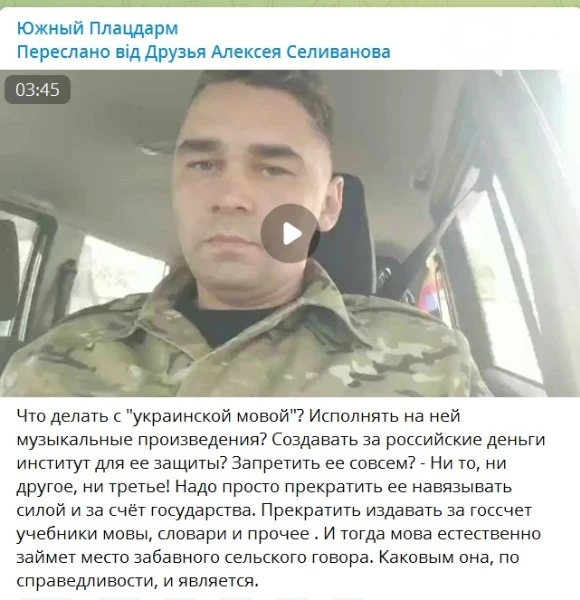
In September, a manipulative post appeared in the Telegram channel of the occupying power "Yuzhnyi Platzdarm", where the anonymous author considers it necessary to tell what Ukrainians should do in their country with the state language.
A video was attached to the text with the collaborator Oleksii Selivanov, who was appointed by the occupation authorities to the position of "deputy head of the Ministry of Internal Affairs in Zaporizhzhia oblast."
“The task of the Ukrainian language is to substantiate the individuality of some Ukrainians and prove that they are supposedly not Russians.In fact, only language blurs the eyes of Russian people, showing that some of these Russian people, who are no different genetically, externally, culturally and even in language, are allegedly a separate people.This is the task of the Ukrainian language.It was for this purpose that it, from a rural dialect, was turned into some kind of language, supposedly equal in size to Russian - they created dictionaries, rules, literature, erected monuments to local poets in order to justify the separateness of all Ukrainian.
Many people think that Ukrainian is equivalent to Russian.To understand what Ukrainian language is, it is enough to turn to our native Slavic language.In Slavic, "language" is the people, and "mova" is translated into Russian as "molv", from the word to molvyty (speak).That is, language is a dialect and a regional dialect turns into a state one only if it is forcibly imposed,” Selivanov said in the video.
"Perevireno. Zaporizhzhia" publication turned to Oksana Merkulova, a linguist, philologist, senior lecturer of the Ukrainian language department of the philological faculty of the Zaporizhizhia National University, with a request to tell where the myths about the secondary nature of the Ukrainian language came from.
According to her, these narratives about the secondary nature of the Ukrainian language in relation to Russian are primarily aimed at confirming the secondary nature of the Ukrainian people.
They have been spreading since at least the 18th century.In his philological works Mykhailo Lomonosov repeatedly stated that the "Little Russian dialect" due to its proximity to the Poles and the fact that they ruled over Western Ukraine for a long time, mixed with the Polish language and "spoiled" as a result.The thesis was used by other Russian figures - politicians, historians and philologists, and at the beginning of the 19th century it was already perceived as an undeniable truth.
The Russian Empire was replaced by the Soviet Empire.And in this new imperial modification the policy of following the peoples of the USSR and their cultural face continued.The Russian language was a prestigious language in all 15 republics: without knowing Russian, no one could even get a job, and there was a prestige salary supplement for Russian teachers.
The non-Slavic (Latvian, Lithuanian, Estonian, Armenian, Georgian, Romanian, etc.) languages of the republics were, so to speak, at least somehow protected by their origin and absolute difference from Russian, so the Ukrainian and Belarusian languages suffered the most.These languages were qualified as inferior, which emerged from the "cradle of three fraternal nations", among which the oldest and best, of course, was proclaimed the Russian people and its entire culture.
Fake 9: The Ukrainian language is used to create hatred for the aggressor country and spread Russophobia throughout the world
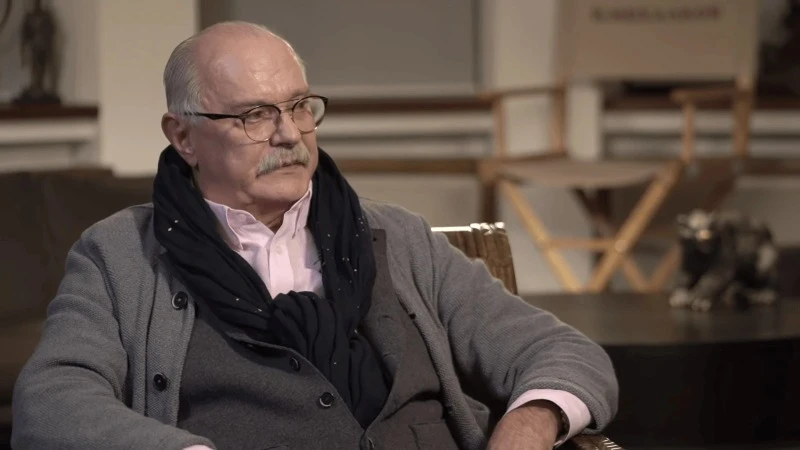
The scandalous Russian actor and director Mykyta Mikhalkov, known for his many years of support for Putin's regime, called the Ukrainian language a "disaster" for Russia, as it is the language used to create hatred for the aggressor country and spread Russophobia throughout the world.
Mikhalkov believes that teachers need to justify the war to children in all temporarily occupied settlements of Donetsk and Luhansk oblast.
Russian-speaking Ukrainians massively started using their native language as the main one because of the beginning of the Russian full-scale invasion. Ukrainians' main thesis: "Every day Russia destroys our cities, brings death, pain and suffering. In other words, it brings us the "Russian world". We don't want to be a part of this "world".
Russian full-scale war against Ukraine not only united and mobilized Ukrainians to defend their state, its territorial integrity and independence, but also awakened reflection on who we are, what makes us Ukrainians, what defines our present and future.For many, language has become a marker of identity - Ukrainian men and women who have been communicating in Russian since childhood decided to speak Ukrainian as a matter of principle.Someone speaks Ukrainian in certain areas of their life, someone has a clear desire to finally break with the Russian-speaking context.
Author: Anton Malynovskyi