

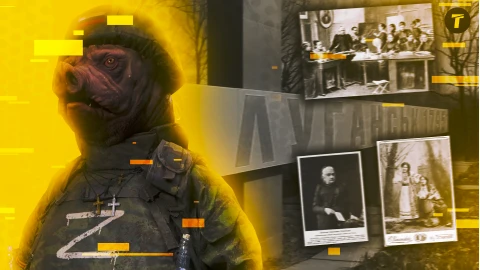
For years, Russia has had an influence on the Ukrainian territories of Luhansk and Donetsk oblasts. Russia has always tried to connect with these oblasts the Russian Federation in order to start a war for expanding territories.
In the occupied territories the Russians are actively promoting the narrative that "Luhanshchyna is historically a region of the Russian Federation".
We are telling why Luhansk oblast has never been Russia below.
"Historical Motherland"
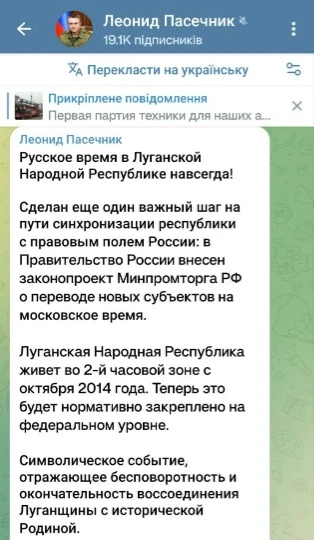
"A symbolic event reflecting the irreversibility and finality of the reunification of Luhansk oblast with the historical Motherland," the so-called "LPR" battalion Leonid Pasichnik writes.
A few centuries ago, thanks to certain external factors, a unique region of Ukraine - Luhansk oblast - was formed. However, it is interesting that the Russian Federation has nothing to do with its creation.Such factors include natural wealth (without the participation of the Russian Federation), the Cossack search for new places (also no trace of Russia, sometimes even against the Russian authorities) and Western European investments (for the Russian Federation, Europe is generally the greatest evil after the "Nazis").
Let's also analyze the real facts that Russia often uses, historical maps of different times.
Here, for example, is the 1928 map "Map of Ukrainian Lands", publishing house "New Ukrainian School", Lviv. The approximate outline of the map of modern Ukraine is shown in red on the map.
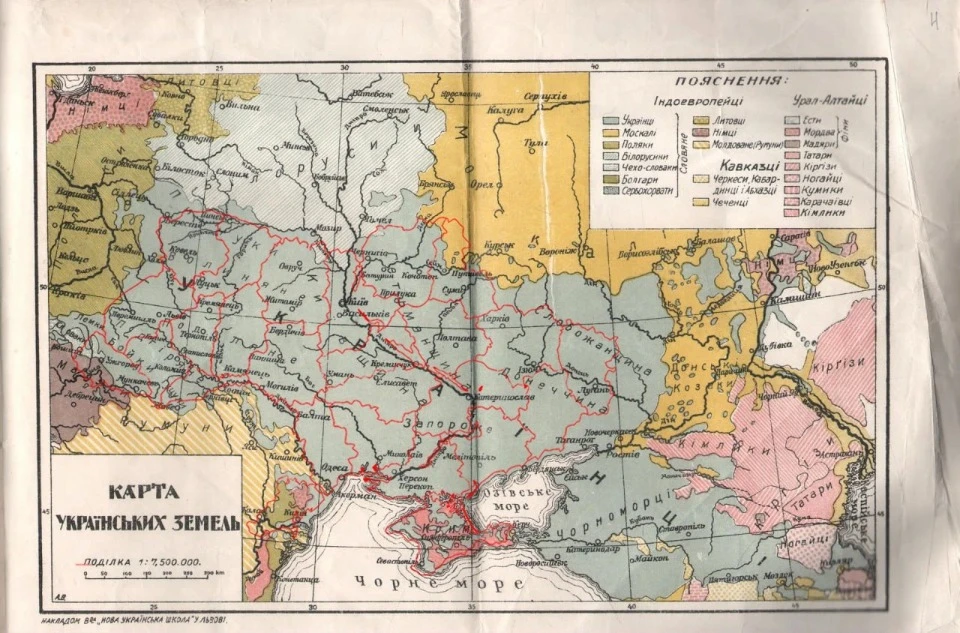
You don't need to be an expert to see that the current territory of Luhansk and Donetsk oblast are part of Ukraine at that times. Such cities as Taganrog and Rostov were also Ukrainian, although the latter was then called "Rostiv".So history disproves propagandist theses about "Russian Donbass". But maybe this is some kind of mistake?
Let's look at another map, which is also publicly available on the Internet. Here is a German map of Ukraine at the beginning of 1918:
It shows that the current territory of Luhansk and Donetsk is part of Ukraine.
In particular, we see the modern names of cities - Luhansk, Starobilsk.So, Russia openly lies when it talks about Russian lands as part of our state.In addition, the Russian Federation in its current form did not appear before Ukraine, but also in 1991 after the collapse of the USSR. The collapse of the Soviet Union accelerated the further degradation of the industrial system, the core of which has been Donbas since the 1930s.
At the same time, huge assets in the form of large enterprises of the oblast became the prey of representatives of local post-communist elites, who, in order to protect their corrupt interests both at the regional and all-Ukrainian levels, began to fan the myth of the special identity of Donbas.
At some point, this tactic was picked up by Putin's Russia, which embarked on the path of reviving the neo-empire. Over the years, a prejudiced, xenophobic perception of the supremacy of Donbas over other Ukrainian oblast was formed.
The basis for these ideas was the imposed opinion that the rise of the oblast was facilitated by the arrival of the Russian/Soviet empire," teacher, historian, philosopher, writer Oleksandr Naboka added.
"We protect Russian speakers in Donbass"The occupiers used this thesis all 9 years to justify their invasion of Ukraine.There are Russian-speaking Ukrainians throughout the territory of our country, and because of this, until 2014, there was never a quarrel.In the eastern oblasts of Ukraine, the percentage of such people increases due to a number of factors: proximity to the borders with the Russian Federation, the Holodomor in the 1930s, and the resettlement of the Russians."According to the censuses of 1927, most of the villages of the modern Luhansk oblast consisted of Ukrainians.The percentage of Ukrainians was also high in industrial cities, in particular, Luhansk.As the Ukrainian-speaking residents of Donbas were associated with peasant labor, the main blow of collectivization and famine fell on them.A significant part of the bearers of Ukrainian culture was physically exterminated, some were "disarmed" and deported to the inner regions of the USSR.Some emigrated to cities that in the 1930s were enclaves of Soviet industrial culture, which is based on the idea that the Russian language is the language of a progressive socialist society in which nations will gradually die out," Naboka explained.
A relevant example would be Aleksii Alchevskyi's family, which invested a lot of effort in the Ukrainian movement.Khrystyna is the wife of the founder of the city of Alchevsk in Luhansk oblast, Oleksii Alchevskyi, a well-known Ukrainian industrialist, banker, public figure and philanthropist (1835 - 1901).
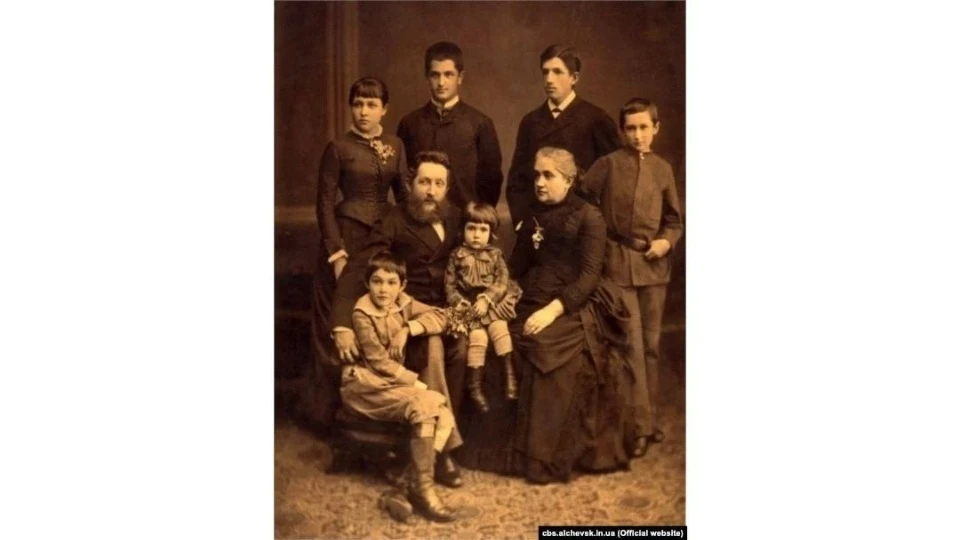
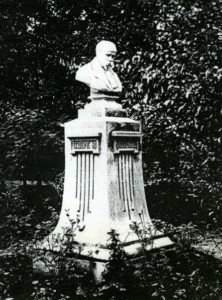
The well-off, educated Alchevskyi's family could afford to challenge the tsarist authority:the first monument to Taras Shevchenko in Ukraine and the world was opened in their estate in Kharkiv, despite the imperial ban on it:
In 1991, the majority of both the Russian-speaking and Ukrainian-speaking population of the east supported Ukraine's independence in a referendum — 83.9% of residents of Donetsk oblast and 83.6% of residents of Luhansk oblast voted for it.
The Telegram channel of a journalist from Luhansk oblast "Artiukh" published valuable archival letters written by a resident of Kreminna. What is important about them is that the text was written in 1968 in the Ukrainian language — and this is yet another proof of the existence of our language.
"Bombed for 8 years"
It is the most common myth, which is actively spread not only by propagandists, but also by the zombified residents of the temporarily occupied territories.Various mass media have repeatedly refuted this fake, and we will only supplement with brief statistics.By the way, these statistics are from the Russians.
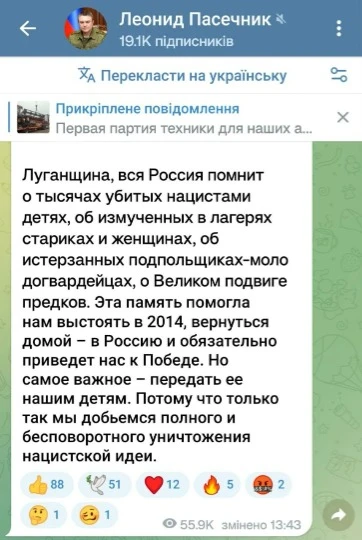
So, in one of his posts, Leonid Pasichnyk writes about the thousands of children killed by the non-existent Nazis:
"Luhanshchyna, all of Russia remembers the thousands of children killed by the Nazis, the old men and women exhausted in the camps, the tormented underground members of the Young Guard, the Great feat of their ancestors.This memory helped us survive in 2014, return home to Russia and it will definitely lead us to Victory. However, the most important thing is to pass it on to our children".
Recent Russian statistics and the vice-speaker of the State Duma say that in 9 years of hostilities, 56 children became victims:
“For us, the death of the little residents of the republic is an unhealed wound and a great pain.During the nine years of hostilities, 56 children became victims of Ukrainian nationalists, the smallest of them was only 27 days old.”
In this way, the occupation administration manipulates concepts and controls the consciousness of Ukrainians in the captured territories, distorts the history of the region. Be careful not to consume Russian propaganda.