
At the onset of the revolutionary events in 1917, the present-day Luhansk region was part of three huberniyas - the Kharkiv Governorate (the northern part of the modern region, predominantly rural areas), the Katerynoslav Governorate (the southern part, where industrial settlements were also located), and partially the Don Host Oblast. Therefore, speaking generally about the region is difficult: the situation in Starobilsk, Luhansk, and Rovenky, for example, could be completely different at the same time.
TRIBUN interviewed historian Olha Drobysheva about the impact of the 1917-1921 revolution on Lugansk region.
Background: Olha Drobysheva is a Luhansk researcher whose articles are based on archival sources, an associate professor at the Department of History and Archeology at Taras Shevchenko National University, co-author of the book "Essays on the History of Luhansk Region".

"Ukrainian historian Yaroslav Hrytsak in his work 'Overcoming the Past: The Global History of Ukraine' says: 'The Ukrainian revolution is like Verdi's opera "Il trovatore": its exceptionally tangled plot is impossible to tell without losing the thread or missing important episodes. Therefore, narratives about the Ukrainian revolution are inevitably selective. Historians choose moments that best fit their schemes.' I resonate with this idea because my revolution in Luhansk is also selective, and I am aware of this," - begins the historian's story.
Olha adds that covering everything is simply impossible, so she will only share her own knowledge and observations. "So far, I have mainly focused on the northern (rural) part of the current region, mainly 1917-1918, and the activities of pro-Ukrainian forces. I examine the revolution in the Ukrainian context, from the perspective of the national revolution. I do not reject the influence of Bolshevik forces in the region or the importance of studying the White movement, I just haven't reached them for a number of reasons (therefore, unfortunately, I cannot answer all your questions). My conclusions and reflections are not the final point; this is the middle of the process of studying the revolutionary events of 1917-1921 as a intertwining of several conflicts," she adds.
Where did the revolution in Luhansk begin?
Historians begin counting from the fall of autocracy, the formation of the Provisional Government in Petrograd, and the Central Rada in Kiev. But events of such magnitude do not happen at once. 1917 is not only the first year of the revolution but also the third year of World War I.
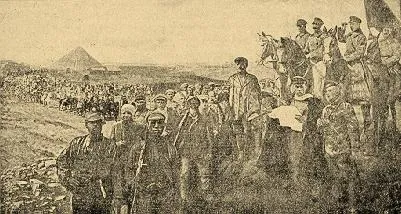
"It profoundly influenced the consciousness of a huge mass of people, primarily peasants. Let's imagine a peasant living somewhere near Novoaidar. His life is routine, predictable. He has a limited circle of communication, his world is the village and the surrounding area. In principle, he can go to work in a factory or a mine. But in case of war, he is mobilized and no longer has a choice. In the army, he enters another world, a world of discipline and technology, he sees other regions, even other countries. Propagandists and agitators work with him, and it is there, presumably, that he first encounters the concepts of socialism and nationalism. Finally, he learns to use weapons and feel their power," says Olha.
Already a year after the start of the revolutionary events, previously mobilized peasants return home.
"At the end of 1917 - the beginning of 1918, they begin to return home, and it is then that a real revolution takes place in the countryside. This, of course, concerns primarily the villages (although even there 1917 was not peaceful). In general, throughout 1917, changes were already taking place, there was a struggle in councils, and, most importantly, there was a surge of national self-awareness, including in the Lugansk region. Therefore, for the revolution to erupt, changes in society had to take place, the catalyst of which was precisely the World War І," emphasizes the historian.
If we talk about the intelligentsia in Luhansk during the Ukrainian revolution of 1917-1921, then the rapid rise of national consciousness in the countryside is associated precisely with the rural intelligentsia.
"Eevhen Chikalenko wrote: find a nationally conscious peasant and you will see the work of a 'teacher' or 'doctor'. For our region, the specificity lay in the fact that the number of intelligentsia, primarily in the humanities, was small. In the industrial part, the elite layers of society were predominantly represented by technical intelligentsia. It's difficult to say which forces the intelligentsia supported at one time or another, certainly, they varied. For example, many engineers and highly skilled craftsmen were associated with foreign capital, which, of course, greeted the arrival of the Bolsheviks with their nationalization (and even the socialist Central Rada did not evoke enthusiasm), so they supported conservative forces. Already in 1918, they began to emigrate massively. Among the local, both technical and humanitarian, some took a waiting position, some emigrated. On the other hand, representatives of the Bolshevik authorities understood that by the time they could 'educate' the proletarian intelligentsia, they needed the services of the old, 'bourgeois'. So, some of the 'old specialists' went on to cooperate with the new state," Olha Drobysheva explains.
The Role of Education in the Revolution in Luhansk Region.
Luhansk "Enlightenment" was founded on April 16, 1917. The following sections existed: artistic-musical, lecture, library, agitation. The "Enlightenment" organized performances, book collections, courses, and introduced an agitation school. It was precisely under the influence of the latter that on June 25, 1917, in Lugansk, a congress of all volost and rural cooperatives was held, convened by the agitation commission of the Ukrainian society "Enlightenment".
"The agenda included the first reading of the Universal Declaration, followed by reports on historical, economic-political, and educational matters," notes Historical Truth.
At that time, the congress unanimously recognized the Ukrainian Central Rada as its highest administrative government in Ukrainian territory.
"'Enlightenment' societies were created throughout the territory of modern Lugansk region (including the southern part) and operated quite actively in 1917-1918," the historian says.
For example, in Starobilsk raion, the main direction of the center was cultural and educational activities.
"Yes, on September 21, 1918, at the initiative of the enlighteners, a Ukrainian bookstore was opened, located in Rudnev's house on Malaya Dvoryanskaya Street (modern Rudnev Street, until 2015 - Volodarskogo). There was also a free reading room with Ukrainian newspapers and magazines. Another direction of activity was assistance in Ukrainianizing education, which was an important feature of the policy of the UNR, especially Skoropadsky's Ukrainian State. Thus, we can argue that the society played an important role in the educational life of the inhabitants of Starobilsk and in spreading the Ukrainian language in the territory of Starobilsk district," notes Julia Shevtsova's student work at Taras Shevchenko National University.
In addition, branches of "Enlightenment" also operated in: Ivanivka, Kadiivka, Lozova-Pavlivka, Oleksiivka, Svatove, Bilokurakine, Bilovodsk, Osynove, Novopskov. Until the Bolshevik authorities closed all of them.
The role of the Bolsheviks, was there aggression towards the civilian population?
"I consciously avoid discussing the Bolsheviks right now. First of all, because there is a need to carefully verify the facts, as there is much distortion. And we do not have access to the archives in Lugansk," says Mrs. Drobysheva.
"As for the aggression against the civilian population by the Bolsheviks, there are certainly many examples of this. Even the very definition of 'red terror' as their official policy leaves little room to imagine anything peaceful and tolerant. But this period was saturated with cruelty from all participants in the confrontation. It was one of my sharpest impressions when I started working with documents. Cases of abuse, torture, mass killings - it's as if there was an epidemic of violence among representatives of all political forces," the historian continues.
She also notes that finding information was quite difficult, although not as hopeless as it seemed.
"So to speak, the 'non-Bolshevik' component of the revolution (the times of the UNR and the Hetmanate, the insurgent movement, etc.) was classified until the late 1980s - early 1990s, so the documents were kept in the central archives in Kyiv. They were mostly not transferred to Lugansk and later, so we can work with them now."
However, a number of memoirs of Ukrainian military personnel of the Zaporozhian Corps of the UNR Army, who were in the territory of Lugansk region in 1918, have been preserved.
With the end of May, Bolshevik cavalry units, sometimes even larger ones, began to break through to our rear and rob the population, kill priests, teachers, and others. Colonel Bolbochan ordered his cavalry to respond in kind," wrote Petro Dyachenko in his own "Memoirs of the Commander of the 1st Cavalry Regiment of the Black Cossacks of the UNR Army."
At the same time, they associated with local Ukrainian military personnel.
"The locality was wonderful: on the other side of Gaidar, there was a plain, and on our side, there were chalky mountains. We quickly got acquainted with the villagers: in the evenings, we sat on logs, joked with local girls, sang, had fun. It was good in the villages then - it was simply unbelievable that there was a revolutionary war raging around," says Igor Verkhovod in the material "Luhansk Region in the Memoirs of Ukrainian Military Personnel in 1918" from the collection of Taras Shevchenko National University.
Was there hunger in Luhansk associated with the revolution?
"We cannot talk about mass hunger, it seems, but there was a critical shortage of food in the summer of 1918 in the industrial areas. 'The situation of the Slovyano-Serbskyi district and the city of Luhansk due to the complete absence of bread is catastrophic, threatening disaster; since April, not a single wagon of bread has been received. Due to the famine, mines and factories are closed' - from a telegram to the Ministry of Internal Affairs of the Ukrainian State of July 10, 1918. This situation led, among other things, to the mass resettlement of workers from cities to villages," says Mrs. Olga.
She also notes that this was preceded by a series of reasons.
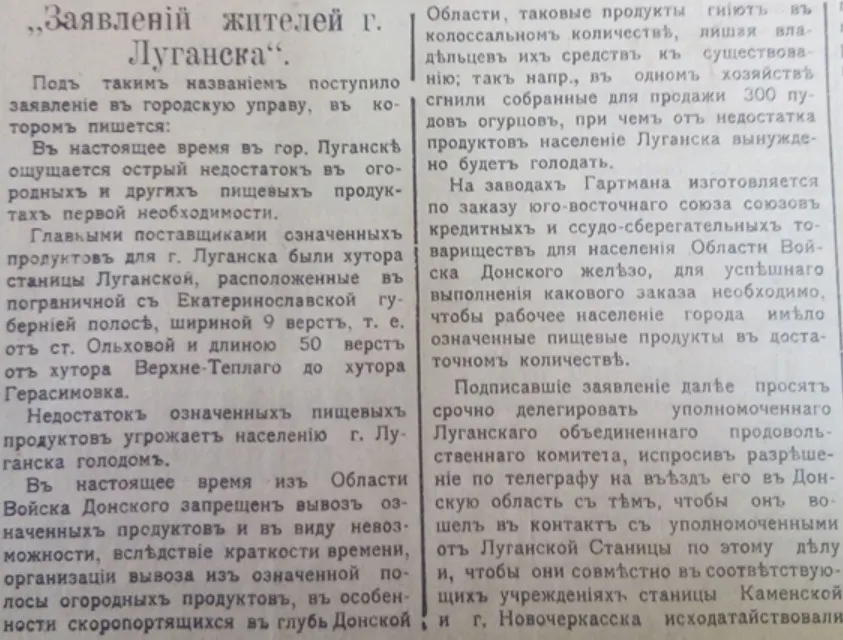
"It was both the cessation of industrial work due to the crisis, and the increase in food shipments to Germany and Austria-Hungary under the Brest agreements, and the severed trade links due to the formation of new borders. For example, the residents of Lugansk appealed to negotiate with the representatives of the authority of the Don Host regarding the supply of vegetables to the city. The point was that Lugansk received a significant portion of them from the territories around the Luganskaya stanitsa, which was then controlled by the Don, and the export of products from there was prohibited. The appeal mentioned that the grown vegetables were rotting because of the impossibility of selling, which affected the producers," explains the historian.
As we can see, testimonies from soldiers, historical sources, and experts testify that the revolution of 1917-1921 significantly changed the Ukrainian context of the Luhansk region - it affected the number of intelligentsia in villages and cities, caused a decrease in the population due to deaths from the crooked terrors of the Bolsheviks, "Enlightenment" was lost as a center of Ukrainianism in our region, and people became poorer, hungrier, and more brutal.