
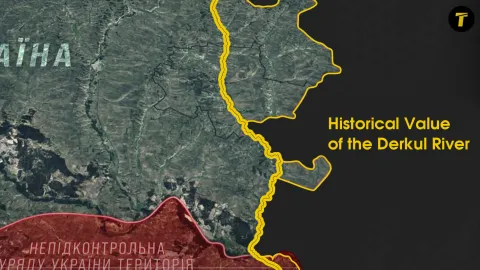
The Derkul is an undervalued river in east of Ukraine, too little is now known about it. Once a fast-flowing river for many centuries, it was meekly shallow and overgrown with reeds, which caused a number of discussions among public activists of Luhansk oblast. And a full-scale war forced us to understand and capture that along Derkul the significant part of the Ukrainian-Russian border passes within Luhansk oblast. However, when the river was still very deep and saw the first people on its slopes and how the Nikolaev Church was built in Bilovodsk, it was an extremely important artery of the region.
TRIBUN talked to historians and searched the literature to find out everything possible about the Derkul River.
A Legend swallowed by water
"I remember how whitewashed the river was because of the washout of chalk from the slopes. It was a long time ago, and I was no longer at home for a long time", — says Vasyl Bondarenko, a displaced person from the Horodishche,Bilovodskyi district of Luhansk oblast.
The man is 80 years old now. He has not been at home since 2014, when his children took him to the Zhytomyr region, where he lives.
"The Derkul is fast and dangerous. In our childhood, we kids were scared that the fish could drag us into the water, "the man laughs," But as an adult, I realized that I should be afraid of the underwater current. She could carry far and at one point”.
He recalls that over time the river began to become very shallow.
"Old people said, so it was when Derkul changed the mouth. It was said that one Cossack hid his treasures on the shore somewhere, and then the river changed its course and swallowed up that crab. It's a legend! Sometimes there were desperate people who tried to find "gold," but no one found it, or found it and did not confess”, — says Vasyl.
Local residents and researchers heard about this legend in different variations.
"I heard this legend in various forms with the Cossack Mark, the founder of Markivka. We can say that this folk legend originates somewhere in the early 18th century, "says historian Olexander Naboka.
No less interesting theories associated with the name of the river Derkul.
About the name and ethnicity
There is one artistic theory. It has no historical confirmation, but it is no less interesting.
"On the bank of the river of our common childhood with the mysterious, already magical name Derkul, where" the parsun of the Scythian.Then the Kyivorussian solar god, called Gor-Kolo, obviously took off, "and which underwent phonetic development over the centuries, in particular, collection and simplification in the chain" Horkolo - Jorkolo - Jorklo - Jorkul - Jerkul - Derkul" — wrote in his travel novel entitled "ARK. Lullaby for death" Serhii Chirkov.
True or fiction, the important thesis that the leading local historians of Luhansk oblast adhere to coincide - people wrote down the name of the river in their time as they heard.
"The name of the river in Russian sources was also written as Derkul, Derpul, Kolodez Derkolov, Derkula, Derkun, Derdukul - as heard or recorded by someone. Toponymists believe that the hydronym Derkul comes from two Turkic geographical terms: dere - "yar; narrow valley, "penetrating into the Turkic languages from Iranian, and köl (göl) -" lake, river. " So, Derkul is "a river in a ravine; a river with steep banks in a narrow valley. " The river and the village of Derkul are also in Kazakhstan, and in the west such names are no longer found. Obviously, this toponym came from Central Asia with the Golden Horde”, — Serhii Kaleniuk noted in his writings.
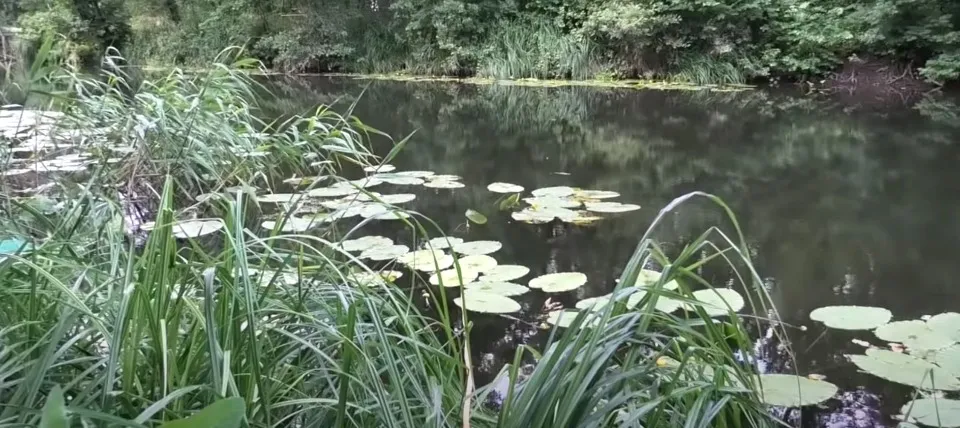
"In terms of the historical and toponymic Derkul, the region of non-Slavic hydronyms ends, which are rich in territory from Aydar to Derkul. Between them there are also Yevsuh and Kovsuh, whose names anyone will immediately say that their origin is not Slavic. And there is also the Bishkin River, the name is similar to the Slavic word, but it is also a hydronym of Turkic origin. And already to the east of Derkul, all rivers have Slavic names. Why is that? Why are the Tatar names of the tributaries of the Donets massively preserved only between Aidar and Derkul?” — Kalenyuk asked questions.
He believed that the names of the rivers Aidar, Yevsuh, Derkul have survived to our times, as references to the Nogai Tatars.
"Today it has already been forgotten that the northern side of the Donets was once called the "Nohai side” and the southern - the “Crimean side”. In memory of this, only the names of the rivers remained, in particular, the Derkul and the Luhan", — the local historian wrote.
Historian Olexander Naboka also adheres to the theory of the Turkic roots of the name of the river.
"The river played an important role as a guide for nomadic tribes that have walked along it since the Bronze Age. In particular, for Turkic peoples. It is logical that the name was formed due to geographical features. The Derkul is in the valley, among the chalk cliffs, "says Naboka.
The historian draws attention to the fact that Kazakhstan also has the Derkul River.
"I believe that the kinship of river’s names in general where the Turkic people walked is due to geographical features. This was common. Probably, the Derkul in Kazakhstan also flows in some deep ravine" —- said Mr. Alexander.
But the main value of the Derkul, according to the historian,it is in the waters of the river, in those that eventually formed stud farms.
"Since 1766, stud farms have officially existed on the floodplains of the Derkul River. However, even before that there were equestrian enterprises, they began to exist about 30 years earlier before the Decree on the construction of the stud farm of Catherine II”, — says Naboka.
The river was of great importance for the Cossacks of its time.
"For the Cossack era, the Derkul is a sacred river, because it often flows among the chalk banks. And the chalk coast in the earlier modern Cossack Orthodox consciousness is part of the idea of some holy lands. Chalk banks have been a symbol of holiness since the Kyiv Pechersk Lavra. So, we can say that the Derkul at one time was a holy river for the Cossacks, at least more holy than the Aidar, for example".
And if you dig even deeper?
"It is generally accepted that Luhansk oblast is a steppe region, but above all it is a river region. Starting from the Neolithic, and then further, in other eras, the river gave the opportunity for trade and technological exchange" — says Olexander Naboka.
According to the historian, rivers, including the Derkul, gave impetus to life, the development of civilization.
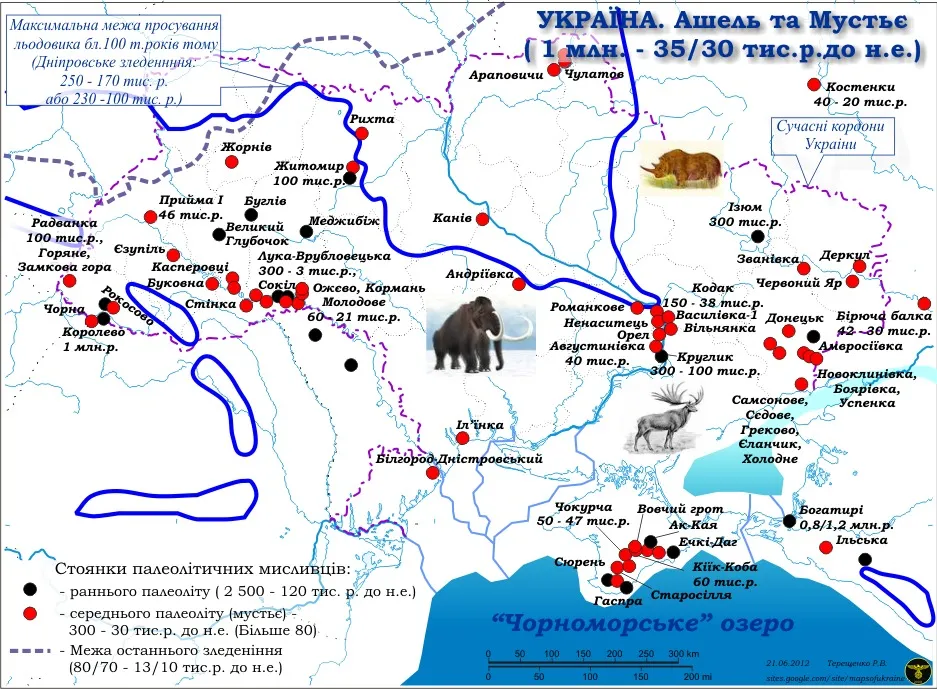
"Derkul appears among the rivers on which, in fact, life was born. I investigated that archaeologists found the oldest settlement of the Mousterian era in the Bilovodshchyna, on the Derkul River'' — adds Naboka.
Background information about the Derkul
Derkul is the left tributary of the Sievierskyi Donets. The mention of it is first found in written sources for 1571.
The river flows through Ukraine within the Markovskyi, Belovodskyi and Stanichno-Luhansk districts of Lugansk region. In Russia” - within Rostov region.
The length of Derkul is 165 km, the right slope is steep, high, the left is gentle. The river is winding, it happens, reaches a width of 30 meters.
On the territory of the reserve "Derkulskyi", approximately in the middle between the villages of Syze and Bolotene from the south and the village of Kolesnikovka from the north, on the boron terrace of the right bank of the Derkul is the biostation of the Luhansk National University "Novo-Illienko."
The following villages are located above the river: Markivka, Communa, Sychevka, Krizske, Bondarivka, Kuryachivka, Harmashivka, Limarovka, Kononovka, Bilovodsk, Horodne, Tretiaivka, Danilovka, Pervomaisk, Horodishche, Frolovka (Russia), Nozdrovka Podgaevka (Russia), Derkulske, Titovka (Russia), Oleksandivka, Mashlykino (Russia), Novoruskyi (Russia), Zolotarivka, Krasnyi Derkul, Ushakovka (Russia), Mozhaevka (Russia), Harasimovka, Yuganivka, Manotskyi (Russia).
Instead of conclusion
Now almost the entire Luhansk oblast is occupied by Russia. Archives where there is information about the Derkul River, local residents who preserve the memory of their native land, with a few exceptions, were in occupation. Unfortunately, to learn more about the river Derkul it will be possible only after the victory of Ukraine in the war with the Russian invaders.