

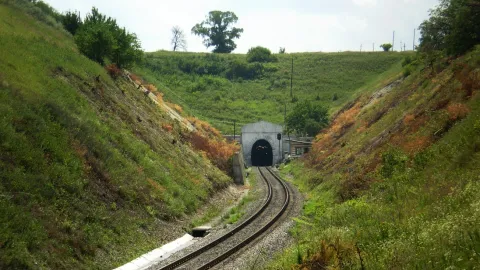
One of the significant tourist "gems" of the Luhansk region is the Lutuhyne Tunnel, located near the Rodakove station of the Luhansk Directorate of the Donetsk Railway, in the very heart of the Luhansk-Donetsk industrial conglomerate. Its length exceeds 2 kilometers, making it the longest structure of its kind in Ukraine. The tunnel was created according to the infrastructural logic of connecting important industrial centers of the former Donbas. Its construction was abundantly surrounded by myths and legends, which, in conditions of chronic information shortage, replaced the true but not less dramatic history.
In the material of TRIBUN, historian Oleksandr Naboka described the real facts about the Lutuhyne Tunnel, relying on data obtained from a local historian and railway communication historian of Luhansk and Donetsk regions, Pavlo Belitsky.

North Donetsk Railway
The active phase of the creation of the Lutuhyne Tunnel dates back to the times of the World War I (1914-1918). It became an important link of the North Donetsk Private Railway, the construction of which began even before the war. To carry out this massive project, a private joint-stock company "North Donetsk Railway Company" was established. The main beneficiaries of the enterprise were the local leading merchant Fedir Yenakiyev and Sergiy Khrulov, a former lawyer from Kharkiv, who was involved in the affairs of the industrialist Alchevsk, who, as is known, committed suicide after bankruptcy. They managed to attract significant foreign investments for the construction of the railway, provided by French banks.
The controlling stake of the "Company..." belonged to the leading Parisian financial institution "Societe Generale". In order to attract a wide range of creditors, 56 thousand bonds were issued, with a nominal value of 500 Belgian francs (equivalent to 187 karbovanets). Thus, the North Donetsk Railway became another object of the Donbas, the creation of which would have been impossible without the involvement of Western European loans.
As noted by the researcher of the financial history of Ukraine, Serhiy Moshenskyi, "The North Donetsk Railway (Donbas-Petersburg) completed the system of main transport arteries of Eastern Ukraine." According to the researcher, prior to this, the leading transportation artery in the region was the Katerynoslav Railway, but its capacity was quite limited. Another railway, the Donetsk Coal Railway, had regional significance.
In 1908, specialists of the newly formed "North Donetsk Railway Company" completed the survey of the line. Construction began in 1909, with the project being developed by Fedor Yenakiyev, and within a year, the first steam trains were already running on the railway.
The logic of further branching and development of the railway network necessitated the construction of the Lutuhyne Tunnel. In the "mythical" version of events, it is claimed that its creation began in 1915, although in reality, work started even before the war, in 1913.
The Lutuhyne Tunnel: Myths and Historical Truth
The actual name of the tunnel is "North Donetsk." At least that's what the Soviet researcher Pavlo Rymkevych calls it in his book "Under the Ground and Under the Water" (1930), which highlights the dramatic process of building the structure. Giving it another name, "Lutuhyne," is likely associated with the myth that it was supervised by the prominent "engineer Lutuhin" (presumably the mining engineer Leonid Lutuhin). According to legend, he made a mistake in his calculations, causing the workers digging the tunnel from both ends to be unable to meet and connect the railway line underground for a long time. Allegedly unable to bear the tension, Lutuhin shot himself, not waiting for the crucial news that the groups finally saw each other.
However, as noted above, this is nothing more than a myth. Firstly, Leonid Lutuhin was a mining engineer, not a railway engineer. Secondly, in 1915, he was alive and working in the Kuzbass region, meaning he wasn't even physically present in the Luhansk part of the Katerynoslav Governorate at the time.
The true project manager was the railway engineer and inventor Serhiy Chayev (1863-1944), who was also known for serving as the deputy minister of communications of the Russian Empire.
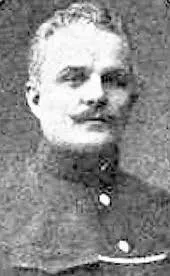
He was faced with quite an interesting technological challenge. Typically, such structures were created in mountains because it's impossible for a railway line to traverse regular passes and trails in mountainous terrain. The area where the Lutuhyne Tunnel was supposed to be constructed was generally flat but intersected by rises and falls—a plain interspersed with elevations and vice versa.
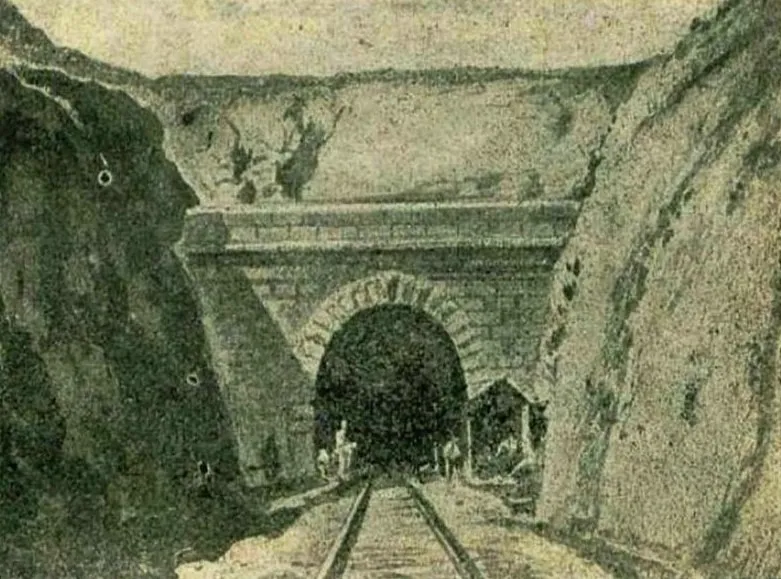
Overcoming these undulating terrains (the highest of which reached 138 meters above sea level) by creating deep excavations or embankments significantly complicated the construction process. To save costs, the decision was made to tunnel through. "The management of the North Donetsk Railway found an interesting solution to the problem. It intersected two small elevations using tunnels. This decision allowed the road to be built in a straight line through the elevations and avoid steep slopes," noted Pavlo Rymkevych. Instead of "expensive" embankments and excavations, two tunnels were constructed - 2058 and 710 meters. As Rymkevych pointed out, "the experience of their construction was very successful."
Despite the widespread practice of tunnel construction at the time, the creation of the Lutuhyne underground structure began only from one end because the corresponding part of the railway had not yet been built from the opposite side. Therefore, the story of two "wandering" groups of workers digging from both ends and unable to meet is also a myth.
At first, nothing hindered Chayev from implementing the project according to plan, which was supposed to complete construction by August 1, 1915. However, somewhere along the way, an unexpected obstacle emerged in the form of water-saturated, floating sandy soil, which slowed down construction.
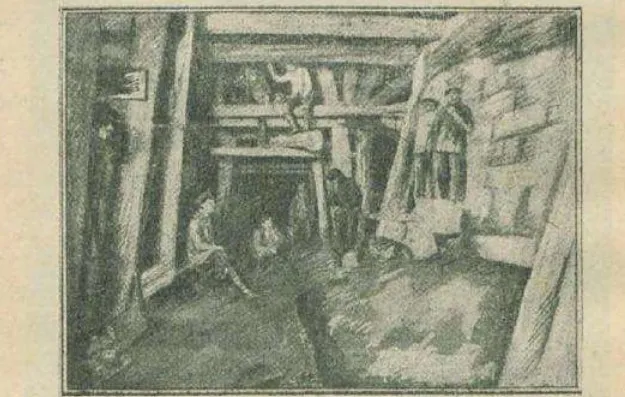
The uncontrolled sand quickly filled all the excavated voids, and creating reliable reinforcements significantly slowed down the work. Despite the efforts of the workers, the floating soil somehow filled about a third of the excavated gallery. Pressure began to mount on Chayev from the leaders of the "Company..." demanding that he finish the project within the set deadline, regardless of the circumstances.
To compensate for the lost time, the engineer came up with an unconventional solution. At his command, two channels were dug on top of the elevation through which the tunnel was being constructed, similar to mine shafts. Workers descended into the gallery through these channels using winches, excavated the floating sand, and brought it up in wagons. Simultaneously, another group of workers continued to dig the tunnel. This again provided the necessary dynamism to the work.
Another problem the project engineer encountered was creating an effective ventilation system. The standard system of ventilation ducts, which pumped compressed air into the tunnel, did not produce the desired results. Much of the oxygen necessary for breathing was consumed by an old freight gasoline car, which traveled on rails with wagons. It was used because the more advanced electric locomotives and pneumatic locomotives, which were already widespread at the time, were deemed too expensive for such a volume of work.
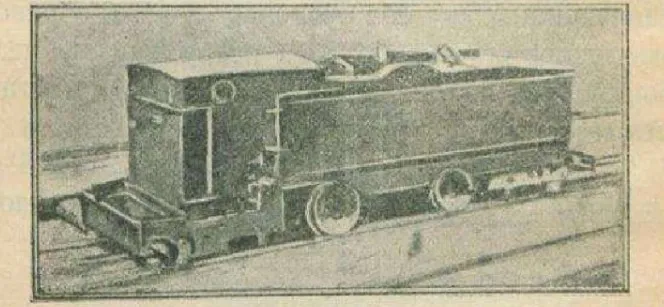
It was decided to dig auxiliary air shafts from the surface to the galleries. Through these shafts, the air heated by the workers' breathing and machinery work in winter, according to the laws of physics, rose to the surface. Accordingly, cooled oxygen was supplied from above through these channels. In the summer, the auxiliary ventilation system allowed maintaining cool air in the tunnel. Special fans were installed in these shafts, which, depending on the needs, either pumped air in or extracted it. As Pavlo Rymkevych noted, this was a "cheap but effective method."
Despite all the difficulties, demonstrating extraordinary skills in overcoming challenging technical problems and having a limited budget, Chayev managed to meet the established deadlines and complete the project. The tunnel was completed in August 1915, and already in January 1916, steam trains began running through it. Today, this unique structure continues to fulfill its infrastructure function, connecting the eastern regions of Ukraine into a single economic system.