

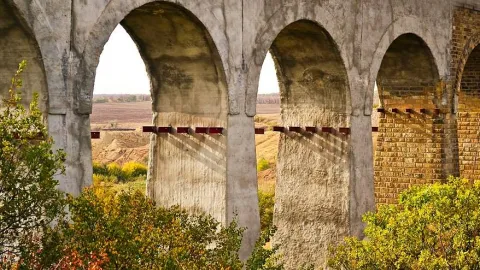
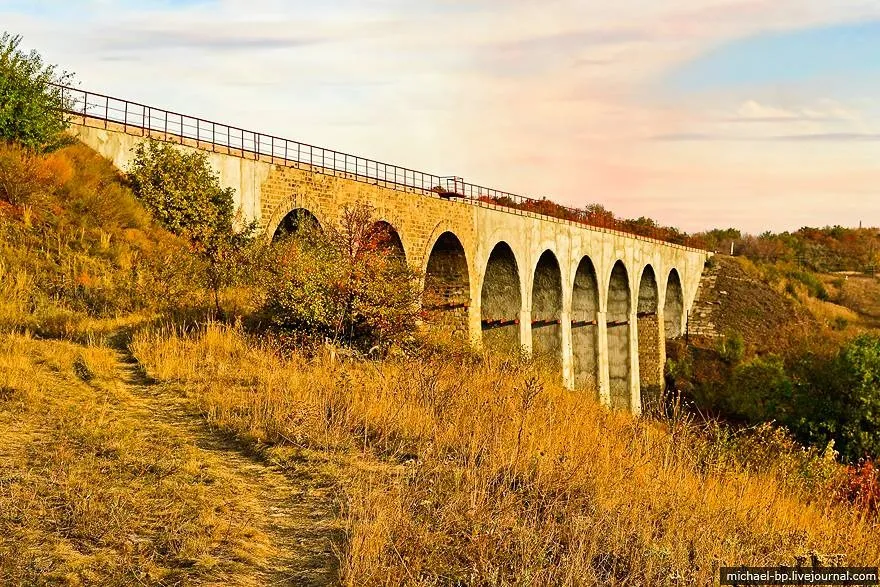
When it comes to viaducts, many immediately list the famous monuments of Austrian and German architecture in Western Ukraine. Few people know that one of those seven surviving bridges is located in Luhansk region, near the village of Donetske, which was occupied in 2014. This bridge is over a hundred years old, and it still impresses with its grandeur and atmospherically gloomy appearance.
In an article for TRIBUNE, historian Victoria Pylypenko explored how it happened that such an atypical bridge construction appeared in a region that was traditionally viewed purely from an industrial perspective.
Background information: Viktoriia Pylypenko, PhD in History, lawyer, researcher of the history of Luhansk and Donetsk regions.

First coal, then bridges
In the second half of the nineteenth century, the south of Luhansk region received a new incentive for development: coal deposits were discovered everywhere in the region. It was no longer a secret that the east of Ukraine was rich in coal: Lysychansk was actively engaged in coal mining, soda ash and other ores production.
However, Lysychansk is a completely different story, connected with the Belgian contribution to the development of the Sloboda part of Luhansk region. The southern outskirts, where the Russian government had a monopoly on the development of mines and the extraction of raw materials, are another matter. Typically Russia was practically not interested in the normal functioning of infrastructure and logistics around the mining sites, and therefore the southern borderlands remained unpopular among colonists, and thus sparsely populated.
The Holubivska agglomeration, which will be the site of the construction of the viaduct railway that is unique for eastern Ukraine, dates back to the service of the Russian landowner Petro Holub.
Petro Holub was a Russian landowner only according to the documents of 1764, when Catherine II granted him this estate along with 6,500 acres of land on both sides of the Luhan River. Holub himself, a lieutenant, a Serb by birth, came to the Russian Empire under a program to promote the settlement of lands bordering the Ottoman Empire by southern Slavs. Most likely, he belonged to the group of people of officers Šević or Depreradović, who initiated the Serbian resettlement to the undeveloped Ukrainian lands in the area of the Siverskyi Donets River and its tributaries.
Since Serbian resettlement was traditionally characterized by the creation of farm-type settlements, Petro Holub's initiative to obtain land for the construction of a farm was not exceptional. First, he built his own estate, and only then brought the four families of serfs, which he had bought, to the land he had been entrusted with. These twenty people were settled in the lower reaches of the Luhan River, and the settlement was named Holubivka.
Until 1830, the inhabitants of Holubivka were exclusively engaged in agricultural activities, combining the cultivation of their own land with the fulfillment of duties in favor of Petro Holub. In addition, the village provided bread to the surrounding settlements, such as Mariupol, Sloviansk, Kharkiv, Berdiansk, and Taganrog, in exchange for fish, salt, iron, and dried fruit. It turned out to be a kind of non-classical chumaks from the agrarian side of Donbas.
Some peasants, not wanting to remain dependent on the landowner with all the duties in his favor, wandered the neighborhood in search of income and thus discovered coal deposits. The easy access to raw materials was due to the characteristic feature of the Donetsk coal basin - the close occurrence of coal seams to the ground surface with an angled dip. For the villagers of Holubivka, the discovery of coal deposits was akin to the discovery of gold in Alaska. The emergence of uncontrolled coal mines indicates the beginning of the black gold rush, which, for some reason, was not a concern of Petro Holub's descendant, the youngest son.
Information about the numerous deposits of coal on the territory owned by Petro Holub's son Ivan quickly spread to the nearest farms and settlements. Therefore, it is not surprising that by 1859 the landowner owned 117 yards with 642 serfs, which made it possible to speak of Holubivka as the most populated place in the Slavic-Serbian province. The formation of the Holubivka coal mine was also completed, the raw materials from which were sold for the needs of the Bakhmut industry and the Luhansk Foundry.
Therefore, it is not surprising that the Holubivske deposit attracted the interest of entrepreneur Umansky, who received the right from Holub to lease the mine for ten years. Under Umansky, the Holubivske coal deposit was completely re-equipped to meet all safety requirements and turned into one of the largest mines in the region, with seams of coking high-energy coal. It is clear that the expansion of coal production required an expanded railroad network.
The appearance of one of the wonders of the Luhansk region - the railway viaduct
Ivan Holub, seeing no prospects for his stay in his father's estate, agrees to sell it for 400 thousand rubles to Yegor Zadler. The new owner of the estate, being the chief engineer for the construction of the Tambov-Kozlovsk railway, initiated in 1868 the construction of a railway capable of connecting the industrial facilities of the Luhansk region with Moscow and the industrial centers of the Russian Empire.
The construction of the railroad network proceeded rapidly. Already in September 1911, the first stage of the North-Donetsk (in Zadler's reports it is called the Severodonetsk) railway was put into operation, connecting Donbas and Sloboda Ukraine with Moscow via the Lgov-Kharkiv-Rodakove-Lykha main line. The railroad was connected to the Kharkiv-Azov railroad, thus providing access to the seaports of the Azov region. After the final completion of the work in 1913, Luhansk region had the widest network of railways, connected to the Moscow-Kyiv-Voronezh, Southeastern, and Southern railways. The new railroad had 36 stations, the most famous of which were Sviatohirsk, Lyman, Yama (Siversk), Sentianivka, Shipylivka, and of course Siphonna, near the villages of Donetsk and Holubivka. To connect the latter, a project of a non-typical railway viaduct was developed.
A viaduct looks like a stone bridge on high supports that is built over a ravine or gorge. In Ukraine, such bridges are considered real works of art, and watching them makes you feel like you're going to Hogwarts to visit Harry Potter.
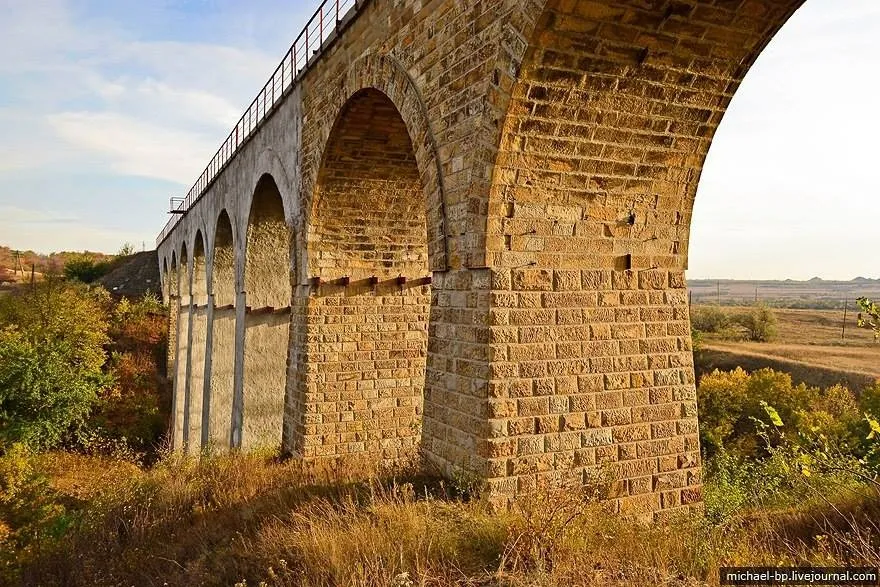
Such a fairy-tale portal was built in 1911 near the village of Donetske, Luhansk region, 170 meters long and 40 meters high. The bridge was built quickly, so it was an alternative to a bridge with high embankments. The masonry for the construction was imported from the Kharkiv Brick Factory and artisanal industrial facilities in Starobilsk. By 1912, the total profit of the railroad section with the bridge amounted to 18 thousand rubles. This was despite the fact that on part of the bridge, the railroad ties were lying on the ground, and there was no ballast of the tracks.
With the outbreak of hostilities in Luhansk region during World War II, the bridge was blown up. This decision was not tactically or strategically justified, but was only part of the so-called "scorched earth" tactic carried out by Soviet troops during the retreat.
During the post-war reconstruction, the viaduct bridge near the village of Donetske was not even included in the list of priority infrastructure facilities for restoration. It was only the need for coal from the Holubivske coal deposit that forced the bridge to be restored. Repair work lasted from 1946 to 1949 without preserving the authenticity of the structure itself. As a result, the arched elevations were raised with reinforced concrete blocks, and the unique stone lintels with monograms of the manufacturers remained lying under the bridge.
After Ukraine gained its independence, the Holubivska mine was recognized as unprofitable. Along with its closure, the railroad line through the village of Donetske ceased to operate. Without scheduled repairs and technical support, the situation at the bridge was declared an emergency.
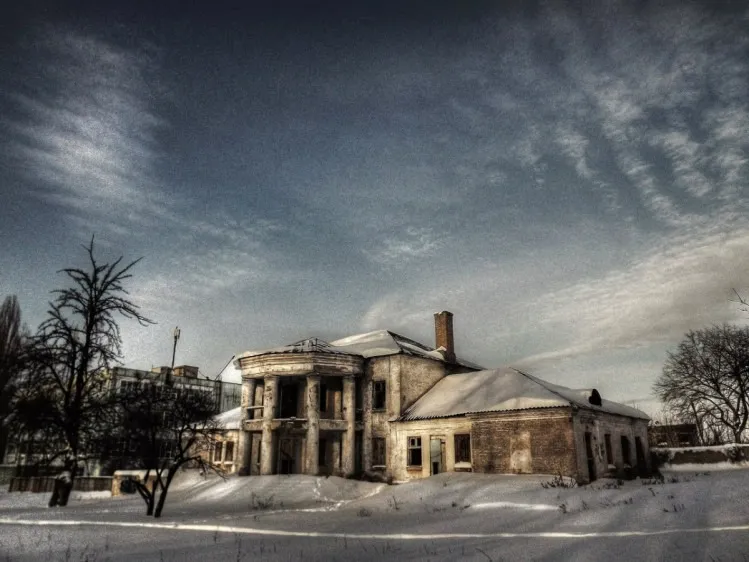
Since 2014, the bridge has remained in a state of disrepair and additionally has been minedd. The estate of the landowner Holub is not in the best condition either, as it has turned from a high-priced property into a shelter for the homeless.
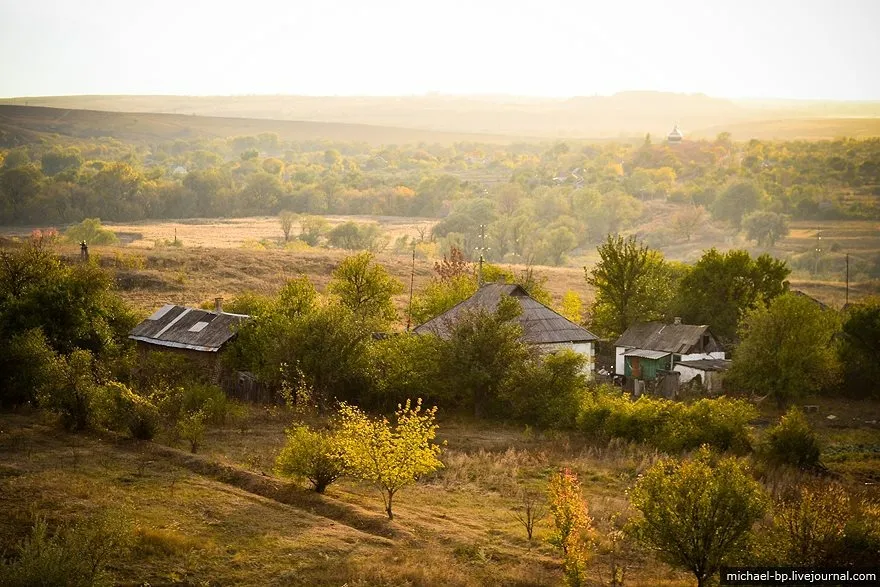
Thus, the history of the landowner Holub's brainchild, the estate and the Holubivske deposit, without which it is impossible to imagine the emergence and miracle of bridge architecture - the railway viaduct - shows how the historical past of Luhansk region is being destroyed. All of them are silent witnesses to the fact that Luhansk is not a Russian region or outskirts, but a self-sufficient territory with a European heritage and Ukrainian-Serbian roots.