
Russian textbooks imported into the currently occupied territories of Ukraine claim that "Donbas is inherently Russian land," but history tells a completely different story—until the Russians took over the Ukraine’s East, conducting purges, Ukrainians lived here and fought for their own freedom.
Historian Valeriy Negmatov from Sieverodonetsk spoke to TRIBUN about the repressions in Luhansk region over the last century and the mass genocide of Ukrainians.
The War with russians has been going on for centuries
Until the beginning of the 19th century, Luhansk region was ethnographically Ukrainian territory with its own language, traditions, ways of life, and customs. Closer to the 20th century, when industrialization engulfed the cities of Luhansk region, there was a need for labor. Thus began the resettlement of the current Luhansk and Donetsk regions by residents of Russian provinces. The standard of living there was lower, so people eagerly moved in search of a better life to Donbas. Historians note that the first wave of settling on Donbas occurred around 1905.
"For many years, we were fed the narrative that nothing Ukrainian happened in Luhansk region, especially in the first half of the 20th century. However, the Ukrainian revolution of 1917-21 proves the opposite. We're talking about the path of the glorious Zaporizhzhia Corps of the Army of the Ukrainian National Republic, commanded by Oleksandr Natiyev," says Valeriy Negmatov.
The historian also notes that at the beginning of 1918, the Corps of the Army of the Ukrainian National Republic was divided into two groups - the Crimean and the Sloviansk.
"The Crimean group of the Separate Zaporizhzhia Division of the Army of the UNR was led by Petro Bolbochan, and the Sloviansk group was led by Volodymyr Sikivich. The latter were tasked with taking control of Luhansk and Donetsk regions and establishing control over the resources of the Donetsk coal basin. And in April 1918, they managed to push the Bolsheviks to the borders of Katerynoslav Governorate," Negmatov notes.
The historian states that Ukrainian soldiers then placed pillars on the border, marking the Ukrainian state.
"However, few reminders of this remain. For example, the grave of the fallen soldiers of the Haydamak Mounted Regiment named after Kostya Levytsky in the Starobilsk district. This regiment was in this area in the spring and summer of 1918. Vandals demolished these Haydamak crosses several times. They believed that 'Bandera followers ' were buried there. The Sloviansk group, meanwhile, guarded the borders," the historian says.
Destructive Repressions of Ukrainians in Luhansk Region
"The Stalin’s regime tried to convince that there were no repressions, that it was a 'struggle against enemies of the people,' but there is evidence of mass repression in the modern Luhansk region," says Valeriy Negmatov.
In carrying out the policy of repression in Luhansk Region, as well as throughout Ukraine, periods of "waves" and "ebbs" can be distinguished.
"The most destructive waves of persecution fall on the years 1928-1933, 1937-1938, 1941-1945, 1948-1953. The first, for example, was caused by the unfolding of two interconnected campaigns - collectivization and industrialization," as stated in the scientific-documentary series of books "Rehabilitated by History."
Repressions had a devastating impact not only on the fates of individuals but also on society as a whole, as well as on the economy
"In Luhansk region, due to the mass deprivation of freedom of industrial and agricultural workers, about 100 thousand people - years (!) were lost in total. The peak of illegal activities of punitive bodies fell on 1937-1938. In just these two years in Luhansk region, almost 13 thousand people were sentenced. The Chekists worked not only on weekdays but also on days marked in the calendar with a red color. The military tribunal of the NKVD troops of Luhansk region sentenced the resident of Kadiyivka T.F. Sergiyenkova to 8 years of imprisonment... on International Women's Day, March 8," the book says.
The intensity of repression reached its peak in December 1937 when 2346 sentences were passed in just one month in our region alone.
"Regarding the residents of the region repressed during the years of the totalitarian regime, such decisions were most often made: execution, imprisonment for various terms, exile beyond the borders of Ukraine, prohibition of residence in certain areas and cities of the country, signing a commitment not to leave the area, and so on. At the same time, any form of punishment could have a tragic outcome. After all, the lives of the repressed were cut short not only by the bullets of the executioners. Thousands of compatriots, not surviving until the end of their imprisonment term, died from hunger, cold, and disease, abuse by supervisors and criminals, from backbreaking labor in logging camps, in deadly mines and quarries," the book adds.
"An example of repression is also the so-called Dry Ravine near Luhansk, not far from the car market. In 1990, they began to build a garage cooperative there, and during the preparation of the foundation, they found a mass grave of people. Experts who were engaged in excavations claim that there are the remains of 5 to 10 thousand people, shot around 1938-1940," Negmatov says.
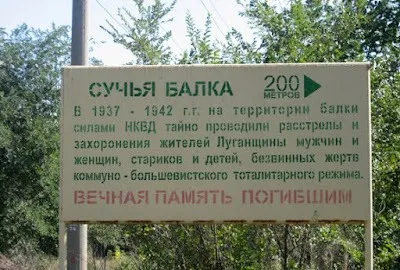
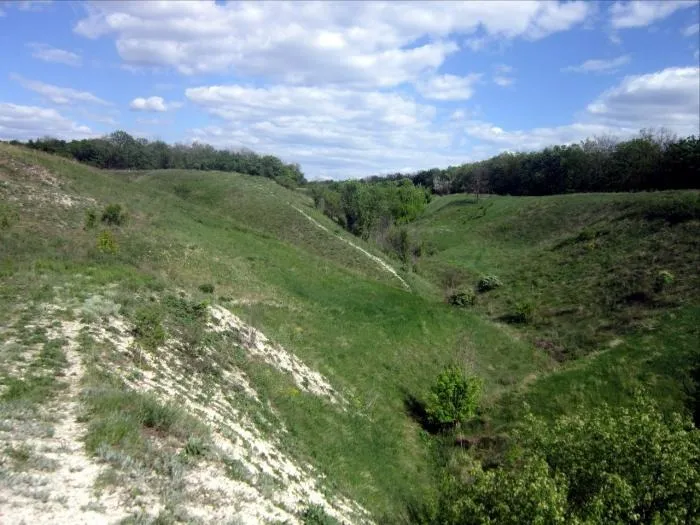
The KGB did everything possible to destroy everything that indicated the atrocities of the Stalinist regime. For example, according to documents of the Luhansk Memorial, which then dealt with excavations near the current car market, allegedly a graveyard of animals that died of Siberian plague was found there. The KGB claimed that animals that died of the plague were buried there. This became a reason for destroying the site of executions.
"That place was flooded with chlorine and rolled over with a roller. There are assumptions that the KGB quickly 'covered up the traces' because remnants of foreign overcoats were found there. They could have been Polish officers from the Starobilsk camp," says Valeriy Negmatov.
There used to be a cross at that place. It is unknown whether it still exists in the occupied Luhansk, but even during the times of freedom, few locals knew what exactly happened there and whose memory that cross was honored. All these people remain unknown to this day.
It is important to note that not only people suffered from repression, but also science, progressive ideas, and attempts at innovation in various fields. Only what could benefit the "development of socialism" was approved by the authorities.
"Babyn Yar" of Luhansk Region
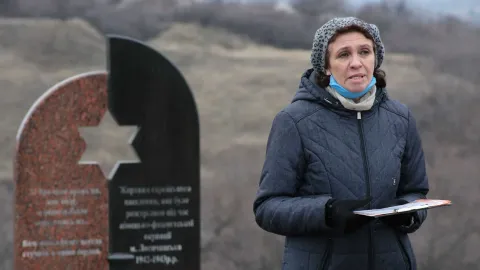
Babyn Yar became the most recognizable symbol of the Holocaust in Ukraine. However, similar mass exterminations of Jews took place throughout Ukraine, including in Luhansk region. Currently, there are two such places known in our region— in Luhansk and in Lysychansk.
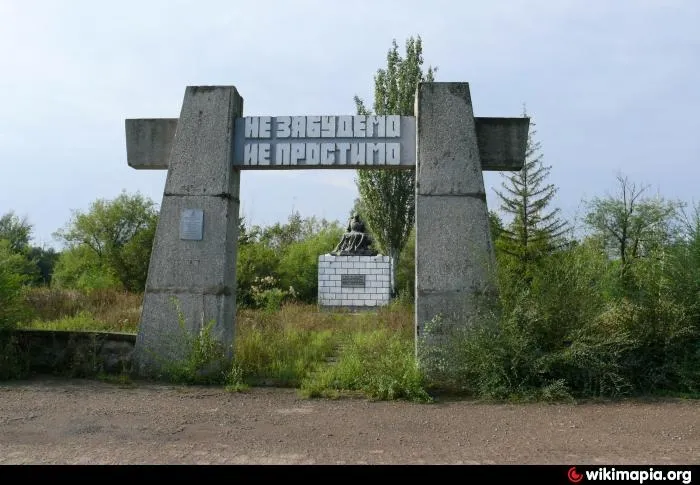
"The Holocaust is the mass extermination of Jews and Roma by the Nazis during World War II. I only know of two places of mass burials of Holocaust victims—in Luhansk and Lysychansk. At the beginning of World War II, there were about 11,000 Jews living only in Luhansk," says Valeriy Negmatov.
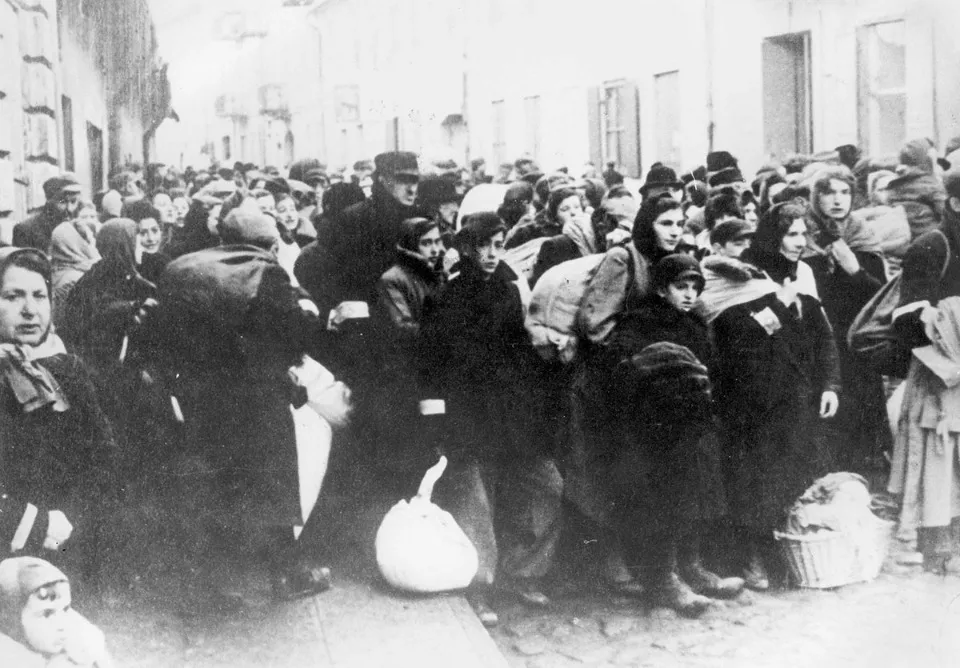
The extermination of Jews by the Nazis began in the fall of 1942.
My grandmother recalled that in November, at first only men were gathered, and then everyone followed—families, where there were only women with children, the elderly, and mothers with infants in their arms. They were allegedly told to gather the most necessary things and promised to send them to Palestine. Many believed, gathered, but never returned. My grandmother had Jewish roots, but by that time she was already married to a Ukrainian with a typical Ukrainian surname, while her sister was a young and beautiful 16-year-old girl. She went with her family to the current 'Avangard' stadium, where people were being gathered. I don't know how, but my grandfather got to know that there was no road to Palestine. I don't know the details, but I know that he bought off my grandmother's younger sister, negotiated with a guard, and she was 'lost' on the way to the 'Sharp Grave'," shares the family story Kateryna Klymenko from Luhansk.
She says that her grandmother only shortly before her death told her this family secret.
"She was so afraid! Afraid that someone would come for her or her sister. Because none of the aunts and uncles ever returned from that 'Palestine'. Overall, we rarely talked about our family roots," adds Mrs. Kateryna.
"After the liberation of the city, it was established that about eight thousand people were shot, the vast majority of whom were Jews," notes Valeriy Negmatov.
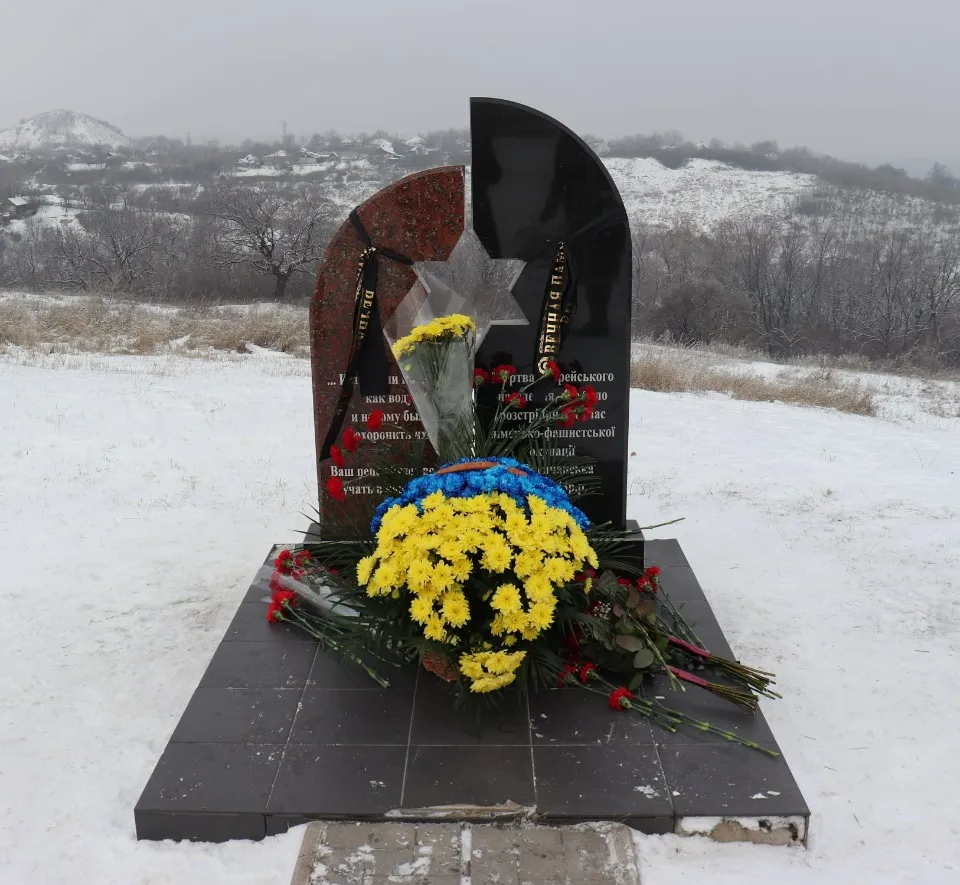
According to the information from the Luhansk Regional State Administration, only in November 1943, about 3000 civilians were shot in Luhansk. In 1945, a memorial complex called 'We will not forget, we will not forgive' was established in the area of the Sharp Grave.
Another memorial sign is located in Lysychansk. It was erected at the initiative of the Jewish community of the city on August 30, 2013, in the area of the city cemetery.
"There is very little information about Lysychansk. We only know the place - the location called 'Durna Balka'. Unfortunately, there are no significant details," says Negmatov.
It is worth noting that both of these memorial places are currently located in the temporarily occupied territory of Luhansk Region.