

Any event in the life of our grandfathers and great-grandfathers, whether it was a holiday or a day of sorrow, could not be possible without bread. Bread had a sacred meaning in the lives of our ancestors, because its production required much more time and effort than now. In Luhansk oblast, information about the unique traditions of baking bread inherent in different communities has been preserved.
Tribun collected in one review everything that is known about a ritual bread of Luhansk oblast.
Life or rye?
Speaking of bread, our ancestors often said "rye," because rye bread was familiar.
"You will not find leavened bread here, but everything sweet, like honey: they gave it to us as alms, but it is impossible to eat it, no matter how much you eat"; "In all Venice and further, up to Rome and to Bari, I did not see black rye bread, only wheat bread everywhere, white as snow, and small as prosecco, therefore it is expensive," - wrote the Ukrainian traveler V. Hryhorovych-Barskyi, who visited Italy in the 1720s and was surprised by the tastes of the locals.
In addition, there is an opinion that life and rye are words of the same root that have a common origin.
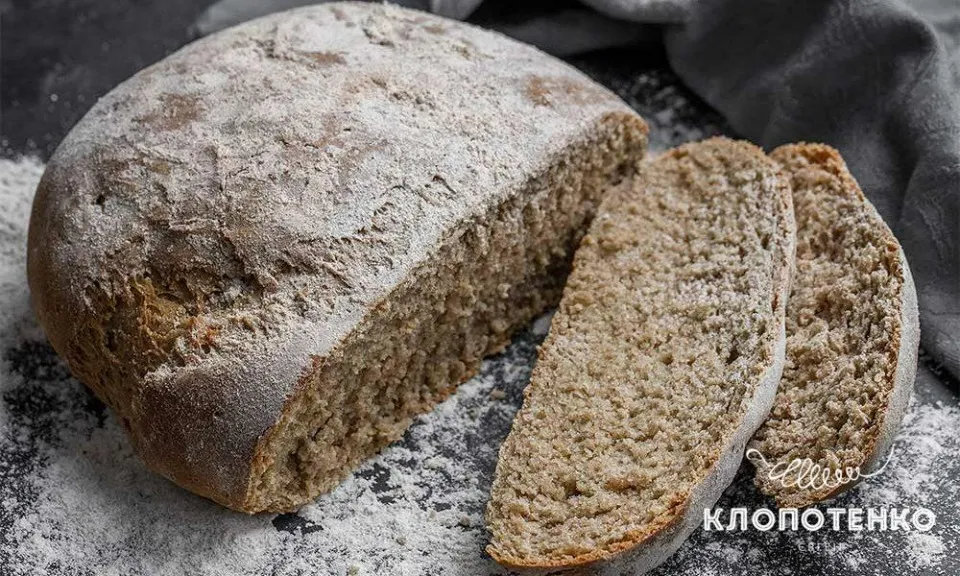
"This makes sense, because, as evidenced by a number of legends related to bread, there was an opinion in society that bread is alive. They said that while bread is mowed, carried and ground, it is alive, but once baked it is already dead, "says historian Oleksandr Naboka.
Oleksandr in his comments on ritual bread refers to the work of Vasyl Ivanov entitled "Life and work of peasants of Kharkiv province."
"At that time, Starobilsk Province entered Kharkiv province. Ivanov also described the current Milovskyi and Belokurakynskyi districts and mentioned Petropavlovka of Stanychno-Luhansk district. His work notes that bread is the very element that holds the connection between the living and the dead, "says Naboka.
For example, in the village of Mykilske, Bilokurakynskyi district, information has been preserved about the tradition that has reached us in a modified form of a glass with a piece of bread.
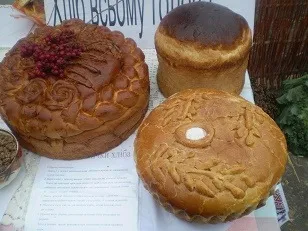
"Those traditions that have reached o us are a symbiosis of Christian and pagan, which was interpreted by our ancestors and resulted in what is now familiar to us. As a tradition to put a glass of bread to the deceased, "- says the historian.
"People believed that the souls of the dead were fed and commemorated by the steam of bread extracted from the furnace and especially broken and laid out on the windows. And when it is pulled out of the oven, the top is soaked so that sinful relatives are remembered in that world, so that God gives them bread and water, "says the book of ethnographer and local historian VasylIvanov.
Almost forgotten
When a child was born in the family they were congratulated t with bread. When the mother sent her son for the journey, she wrapped a piece of rye bread in a towel.
"One of the traditions associated with bread, which my grandmother taught me in Belovodschyna is to wrap a dry piece of bread in gauze or a natural thin cloth and give it to the baby when the teeth are cut. Now there are teething toys for this and this tradition has passed away, but it is worth remembering, "says Maria Kosachenko from Luhansk oblast.
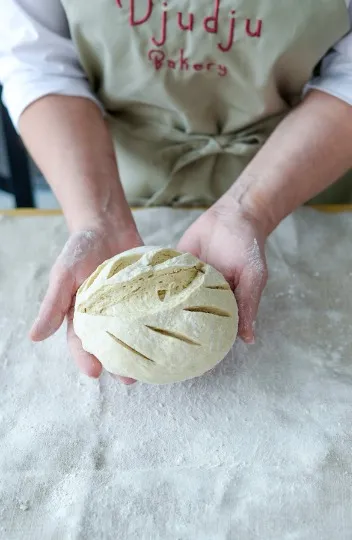
Bread has also always been an indispensable companion of calendar holidays. On Easter, people baked Easter cakes throughout Ukraine, but in Borivske, Luhansk oblast on the 40th day after Easter, they baked "Lesenki with crutches."
"This is the tradition that was passed from the older generation to the younger, but in our time not every yard has already been fulfilled. Previously, this was something mandatory: how to bake Easter cakes for Easter, so to do "ladders" for the Ascension of Christ, "says Tatyana Ivantsova, an IDP from Borivske.
She notes that her grandmother taught her this.
"There was a belief that with this" blade "we sent Christ to heaven after he came down to us on Easter. And the crutch - so that it would be easier for him to rise. At least I was taught that way, "the woman adds.
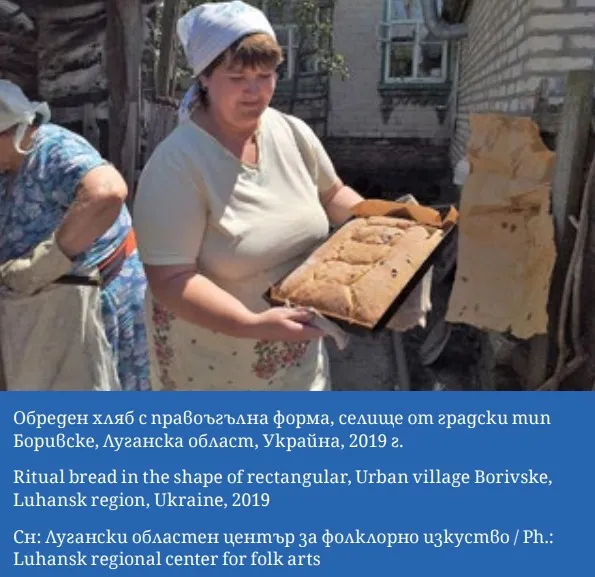
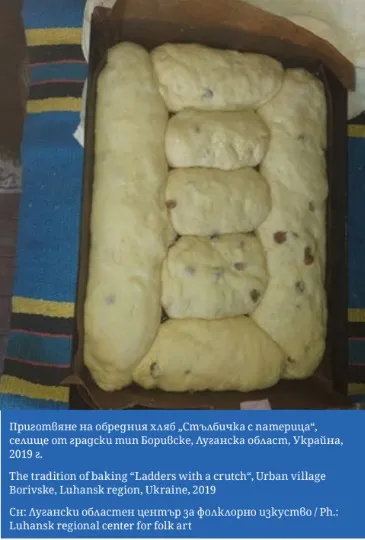
"And the dough is like a loaf, only spread on a rectangular baking tray, spread the dough with a ladder, brush itwith a mixture of milk and eggs. And most importantly at this time we are silent, "Tatyana shares the secret of baking.
Even our ancestors also met the first birds festively - women in the village of Mikhailivka in Novoaidarschyna baked ritual bread in the form of birds with the whole family.
"In Novoaidar itself, I do not remember this, but when I went to my grandmother in the village, I sculpted something similar to birds with her. The fact is that my grandmother died early, I was a child, so we sculpted literally several times. I remember that at the heart of everything was a cross of two such dough strips laid on top of each other, "says Daria Litvin from Novoaidar.
Luhansk Regional Center for Folk Art notes that these birds were baked the day before on the day of 40 Holy Martyrs.
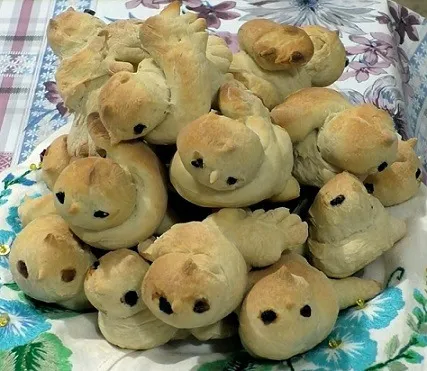
"In ancient times, on March 23, the day of the return of all birds with faith, our ancestors went out to inspect the spring field. They carried bread and salt and a whole basket of lark birds. They came, worshiped the mother lands, and asked her for a good harvest in the new agricultural year. Then they went around the field and put on each of its corners a baked bird for the animals to appease them, and they did not spoil the field. The next day they watched if the animals were treated. A good sign was when not a single baked bird was found in place. Other birds were distributed to children who also had their own traditional mission - to call for spring, "the center of folk art notes.
For a wedding in Luhansk oblast it was customary to bake a loaf and in some places cutters. And if everything is more or less clear and familiar with the first, then with the second it is interesting.
In Troitsk district there was a rite "Wedding ceremony of baking the carving of Kostenko-Kushnariov family." Wedding carving is, one might say, a wedding tree, which was decorated with a loaf. And if under baking "ladders" had to be silent, then here they sang songs, condemned signs and conspiracies for the happiness and easy fate of the young. At the end of the wedding they sharply dismantled the carving and gave guests as gratitude for sharing the holiday with them.
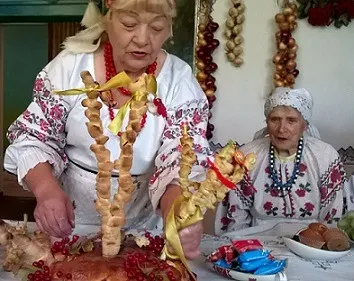
But "Kudryashevskaya wedding carving" from the Kreminsky district differed from its neighbor in that it was decorated not only with colored ribbons, but also with viburnum, flowers or hops.
It is important to emphasize that bread eventually acquired different beliefs, myths and sayings.
"Local historian Vasyl Ivanov cited many sayings related to bread. I remember the following from Belokurakyno: "When putting it in the oven, do not slam the door, because the maids will settle." This reflects a respectful attitude to bread. Also, past generations believed that it was impossible to bake bread on Fridays, especially rye bread, "says Oleksandr r Naboka.
As you can see, bread accompanied our ancestors at all stages of life and played a big role in culture, life and the establishment of life in the past.