

In 2022, due to Russia's full-scale invasion of Ukraine, Luhansk Taras Shevchenko National University experienced its second evacuation to Poltava region. The key center of the university was the old city of Lubny, where its administration and main structural units were housed in an architecturally amazing building. As it turned out, its architect was Oleksii Beketov, the creator of a number of buildings, including those in Alchevsk, Luhansk region.
In an article for “TRIBUN”, historian Oleksandr Naboka explains the importance of architect Oleksiy Beketov's contribution to the development of Luhansk region.
Background information: Oleksandr Naboka is the head of the Department of History at Luhansk Taras Shevchenko National University, author of many publications on the history of Luhansk region, author of books, scripts for theatrical productions, publicist and organizer of performances.
As in Starobilsk in 2014-2022, Luhansk professors in Lubny were lucky to have a building provided by the local authorities at their disposal. Even a cursory glance at the building reveals its uniqueness, that it has a history. The entrance façade, decorated with massive decorative columns, bears an inscription: "1907" - the year of construction.
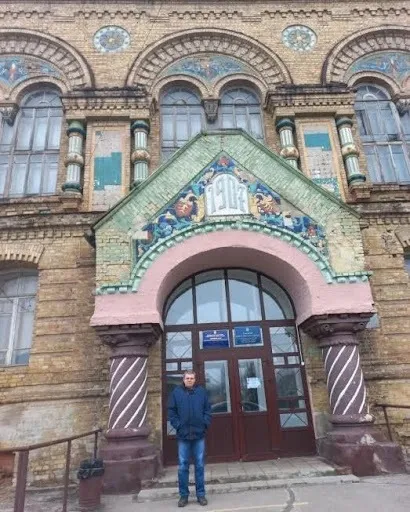
The building plays with rich mosaic colors, which creates the feeling that it is not a stone structure but a huge cake. The author of this text repeatedly came up with such analogies when he saw churches of the late XIX and XX centuries in Kyiv and, especially, in Kharkiv.
Such "gingerbread houses" were an architectural feature of the reigns of Russian emperors Alexander III and Nicholas II. This "saccharine" style was primarily a feature of Orthodox religious buildings. It was characteristic of the "Neo-Byzantine" style that was popular at the time. The model for their architects of the time was the Church of the Savior on Blood, which began construction in St. Petersburg in 1883 on the site of the emperor Alexander II's death. Over time, the "Neo-Byzantine" "saccharine" style began to dominate. It can be traced in buildings that had at least some connection to the Russian Orthodox Church.
However, the façade's "saccharine" style is nothing more than a tribute to the building's church orientation. On the whole, it was created in the architectural style of pompous Art Nouveau, which was used to build office and retail space, apartment buildings, banks, government and commercial institutions. "Art Nouveau" is Volodymyrska Street in Kyiv, Sumska Street in Kharkiv, and Belgian buildings in Lysychansk. "Modern" is the merchant Rudnev's trading house on Soborna Square in Starobilsk.
The "local history instinct" led to my interest in the history of the Lubny building. It turned out that its architect was Oleksii Beketov (1862-1941). He is known to have been one of the key Ukrainian architects in the first half of the XX century. However, his formation as a professional took place in the Luhansk region at the end of the previous century.
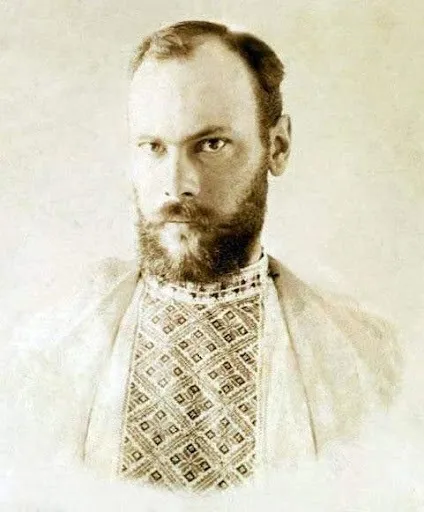
Traditionally, Beketov is called one of the key architects of Kharkiv, where more than forty "modern" buildings were built according to his designs, which today are symbols of the "indestructible city." Having studied his craft in St. Petersburg, he could have made a successful career there, but he consciously chose the capital of Slobozhanshchyna as his place of life and work.
A deeper look into the biography of the young man dressed in ceremonial embroidery for the photo shows that, as noted above, he "honed" his architectural style in the Luhansk region. He shaped not only the urban face of Kharkiv, but also the industrial Alchevsk, where he worked from the very foundation of the town in 1895.
The famous founder of the city was a prominent merchant, industrialist and philanthropist, Oleksiy Alchevsky (1835-1901). In 1895, in the settlement of Yurivka, he founded the Donetsk-Yurivka Metallurgical Company, an industrial enterprise in Donbas founded on the basis of attracting national capital, without foreign investment at first. At that time, it was an exception to the rule.
It should be noted that the Alchevsky family has always supported and promoted the development of Ukrainian culture. Back in the 60s of the XIX century, Alchevsky founded the cultural and educational society "Hromada", the leading role in which was played by his wife, Khrystyna, who was called "Hetmaness" for her devotion to her native culture.
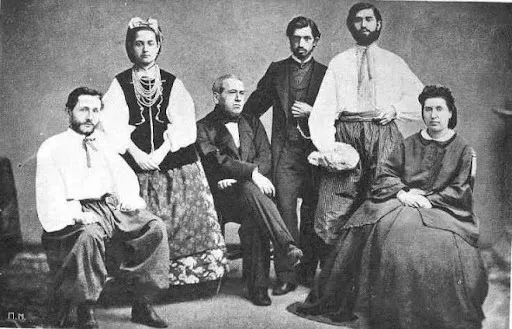
Alchevsky continued to support Ukrainian education and culture even after he expanded his commercial activities in the Luhansk region. Not far from the metallurgical plant, in the village of Oleksiivka (now the village of Mykhailivka, Alchevsk district), he funded an exemplary school. It is known that a prominent Ukrainian writer and scholar, author of the Dictionary of the Ukrainian Language, Borys Hrynchenko, worked there for seven years.
Under the conditions of the Ukrainophobic orientation of the imperial Russian officials, Hrynchenko taught children the basics of Ukrainian life almost underground.
"Although the school in Oleksiyivka was not a Ukrainian school, the students who were educated there knew that they were Ukrainians, knew the history and geography of Ukraine, knew about all the prominent writers and their works, knew about the plight of Ukraine, knew about Galicia, probably more than the average Ukrainian intellectual of the time, and were able to express their knowledge in a good Ukrainian language," the writer noted.
It is likely that the Alchevskys knew about, but did not object to, Hrynchenko's desire to provide Ukrainian education to his students underground.
Architect Oleksiy Beketov was not a random person in the pro-Ukrainian Alchevsky family. His wife was Halyna, the daughter of Oleksii and Khrystyna. On the eve of the plant's opening, in 1894, he had just received the title of academician of the St. Petersburg Academy of Arts, meaning that he was a professional in his field, already known in Kharkiv. That is why his father-in-law engaged him in the development of the future Alchevsk. Fulfilling Alchevsky's order, Beketov created projects for the construction of the Alchevsk railway station, the first school, houses for foreign specialists, and the administration of the plant.
According to Ukrainian architectural historian Oleksiy Shyrochyn, the one- and two-story buildings in the Ukrainian Art Nouveau style, of which Beketov was a representative, were called "beketovki" by the townspeople. It continues to be an "architectural gem" of the "old town" of Alchevsk today.
According to another expert in the history of architecture, Serhiy Boroznov, Beketov built more than 100 buildings in Donbas (not only in Alchevsk, but also in Makiivka and Horlivka). A characteristic feature of his work in the region was the use of local sandstone, which is abundant in the Donetsk ridge, in combination with clay bricks for wall construction.
One of Beketov's key projects in Alchevsk was the L-shaped house of the director of the Donetsk-Yurievsk Metallurgical Society, which he designed in collaboration with engineer Pavlovych. A modern feature of the building is its high hipped roof, which gives its façade an asymmetrical appearance.
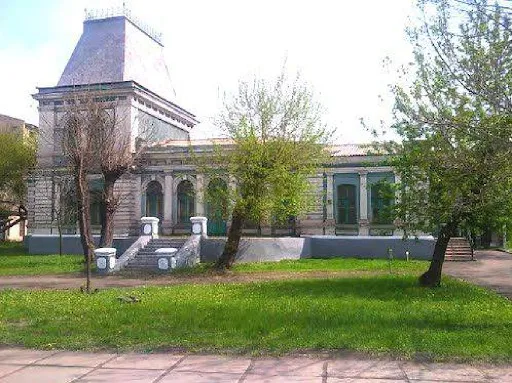
The building of the iron foundry, built by Oleksii Beketov in 1900, looks like a real extraordinary architectural masterpiece, vaguely reminiscent of a medieval fortress.
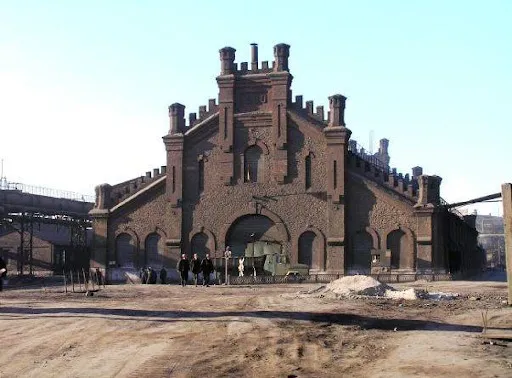
"The factory had the characteristic features of the so-called 'brick style' architecture with elements of classical architecture," noted Boroznov.
Unfortunately, despite its historical and architectural value, the building has not been preserved. In 2009, the plant's then management decided to dismantle the former iron foundry.
Beketov's architectural experiments in Alchevsk were effectively curtailed after the tragic and mysterious death of his father-in-law in May 1901. According to the official version, Oleksii Alchevskyi committed suicide in connection with possible bankruptcy.
The death of the main client forced the Beketov family to return to Kharkiv and take on commercial orders. Among his projects of the early 20th century was the building of the Lubny Women's Parochial School.
Today, Beketov's completed projects can be found in Kharkiv, Poltava, Luhansk, and Donetsk regions. They are proof that our region in the late XIX and early XX centuries was part of a single cultural space with other regions of Ukraine. This contradicts the Russian imperial dogma that the Luhansk region was guided in its civilizational development by the Great Russian canons.