

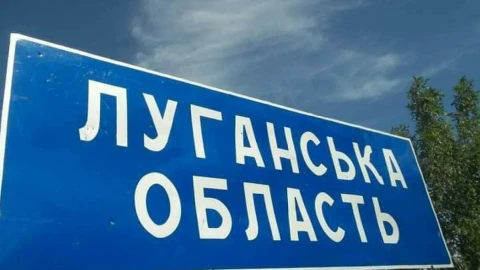
In 1991, 84% of Luhansk region residents supported the restoration of Ukraine's independence in a referendum. However, the Russian propaganda campaign emphasizes that Luhansk has no Ukrainian past.
In this article, TRIBUNE will present 5 facts that completely refute the thesis that Luhansk region is a Russian territory.
1. Dissidents and Sixtiers activists from Luhansk region
Dissidents from the Luhansk region have made a significant contribution to the struggle for human rights, national identity and democratic values in Ukraine. They are direct proof that the region has a pro-Ukrainian past.
Luhansk region, like other regions of Ukraine, has given the country and the world many well-known dissidents who fought for freedom of speech, human rights and Ukraine's independence. A striking example is Mykola Rudenko from Yurivka, Luhansk district. He was one of the founders of the Ukrainian Helsinki Group, which defended human rights and monitored violations of these rights in the USSR. The dissident openly criticized Soviet economic policy and repression, and played a significant role in the international recognition of the struggle for human rights in Ukraine.
Also worth mentioning are dissidents Ivan and Nadiya Svitlychny, and the Sixtiers artist Vasyl Holoborodko. Luhansk region was also close to many talented people, who lived and worked in Luhansk region. For example, Borys Hrinchenko, Volodymyr Sosiura, Alla Horska, Ivan Nyzhovyi, Petro Bilivoda, and others.
2. Artificial famine
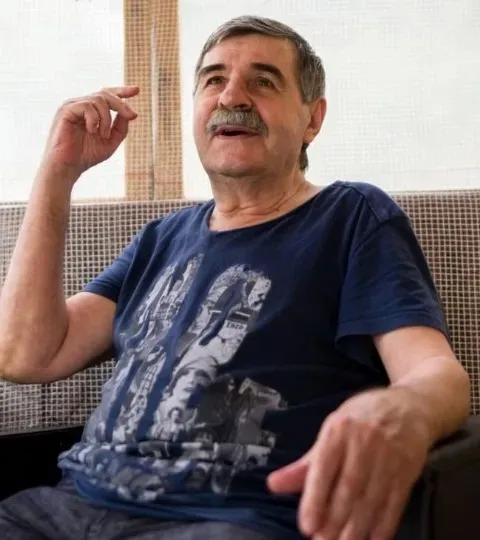
The terrible famine of 1932-33 claimed the lives of a large number of Ukrainians in the Luhansk region and beyond. The exact number of Ukrainians killed is not known for certain, but according to various estimates, the figure ranges from 2.2 to 3.5 million. According to research by the Ukrainian Institute of National Memory, at least 308 people died in the village of Demyno-Oleksandrivka, 247 in Raspasiyivka, 78 in Voyevodsk, 202 in Tarasivka, 401 in Yama, 8 in Poltavske, 254 in Topol, 32 in Arapivka, and 34 in Novoznamianka, Novooleksandrivka - 144, Novochervone - 366, Tmonove - 65, Babycheve - 57, Lantrativka - 64, Rozsypne - 105, Lozno-Oleksandrivka - 370, Bilokurakyne - 387, Nyzhnia Duvanka - 242, Svatove - 1291, Starobilsk - 428, Preobrazhenne - 410, Honcharivka - 325, Novopskov - 99, Kreminna - 127.
As of June 2023, the Holodomor was officially recognized as genocide of the Ukrainian people by 32 countries. Thus, the murdered people became proof that there were Ukrainians in the Luhansk region who interfered with the Soviet government. And this completely destroys the thesis of Russian propagandists.
3. Cultural heritage
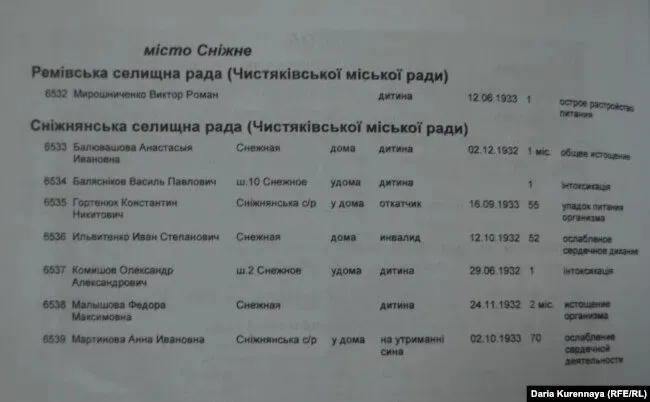
Cultural heritage is a direct proof of the existence of people. In 2018, a register of intangible cultural heritage was created in the Luhansk region. In the same year, a number of cultural treasures were added to the register: Novopskov kulish, Pavlivka kapustnyak (cabbage soup) with fish, authentic songs of Tsiluykovo village in Bilokurakyno district, peculiarities of the dialect of Borivske village residents, the wedding rite of baking a carving of the Kostenko-Kushnarev family, fairy tales and fables of the Veretsun family of Troitske district, and others.
Markivskiy distrtict is famous for its folk songs, and its residents are true carriers of folk songs. The Luhansk Regional Center of Folk Art writes that group singing, where the chest method of sound production prevails, is natural for Markivskiy district, and this is especially characteristic of the Luhansk region.
It is impossible not to mention the embroidery of the Luhansk region, which is characterized by red and black colors, sometimes with blue threads.
4. Luhansk region is on historical maps
If the Luhansk region, according to Russian propaganda, is part of the Russian Federation, then why is this land not part of Russia on ancient maps? The answer is very simple: the northern part of Luhansk region was part of Sloboda Ukraine. Today, Sloboda Ukraine covers the central and southern parts of Sumy region, Kharkiv region, the northern part of Luhansk region and the northeastern part of Donetsk region, the western, eastern, and southern parts of Belgorod region, the southern part of Voronezh region, and the western part of Kursk region. Sloboda Ukraine was formed as a result of the colonization of the Wild Field by Ukrainians in the 2nd half of the XVII and XVIII centuries.
In Novopskov, there is even an ethnographic complex called the Sloboda Yard of the late XIX and early XX centuries. It recreates the life of the Sloboda Ukraine of that time, as well as the local peculiarities of the Novopskov region: unusual patterns on towels, clothes special for the region. The complex was created on the basis of the house of a local priest who led services in the church of St. Nicholas the Wonderworker, the regimental church. However, the unique object is currently under Russian occupation, so its existence is currently unknown.
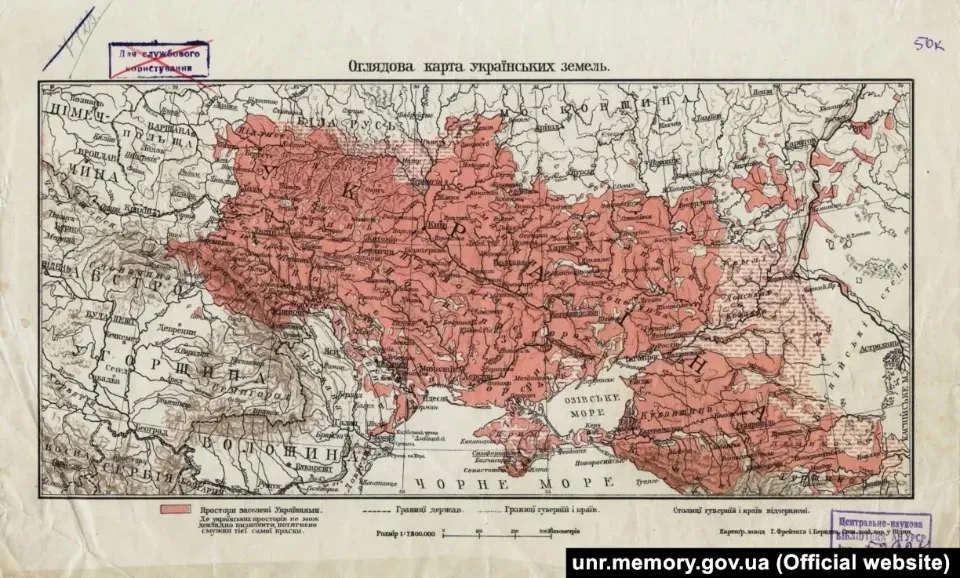
According to the "Overview Map of Ukrainian Lands" compiled by Stepan Rudnytskyi (1917), the rest of the Luhansk region was part of the Donetsk region:
5. Ban of the Ukrainian language
If the Luhansk region is part of the Russian Federation, why was the Ukrainian language taught there? In 1879, in the village of Oleksiivka, Khrystyna and Oleksii Alchevskyi built a one-class primary school. They taught Ukrainian, history, reading, and writing. But what happened next?
Alexander II issued the Ems Decree, which banned the Ukrainian language and writing. Accordingly, Ukrainian-language education was also banned. Therefore, Alchevska decided that it was better to educate women at least in Russian. In total, Khrystyna Alchevska helped more than 17,000 women to receive education. So if there were no Ukrainians, there would be nothing to ban.