


Except preparations for the pseudo-referendums in early October, Russian propagandists often wrote about the "attacks on civilian infrastructure by the Armed Forces of Ukraine" and the quick "restoration" of the cities of Luhansk oblast captured by the occupiers.
We made a brief review of some publications made on local Telegram channels and explained why the presented information is fake.
Shellings
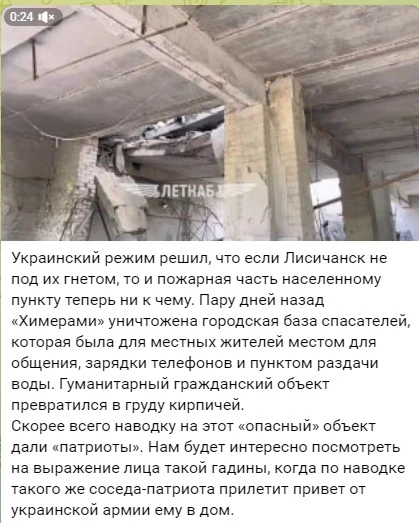
On the LENTAB channel, propagandists stated that the Ukrainian Armed Forces had fired at a rescue station in Lysychansk, which, according to them, "was a place for local residents to communicate, recharge their phones, and collect water." It is interesting that the news about the shelling of the fire station for a very long period of time is absent both in the Ukrainian mass media and social networks, and in media and resources controlled by the Russians. On September 28, shells really hit the building of the water supply company, in which one of the headquarters for the organization of the pseudo-referendum was located. In addition, the strike was carried out at night, when the civilian population was not there. The same resource in one of the following publications writes about the attack on the college in Novoaidar: "Among the objects, information about which the Ukrainian Armed Forces were interested in, there were exclusively civilian objects located in Novoaidar raion", but again - according to mass reports from locals, the college building was occupied by Russian invaders, not refugees, as channel administrators claim.
In general, at the beginning of October, propaganda resources traditionally devoted a lot of attention to this topic.
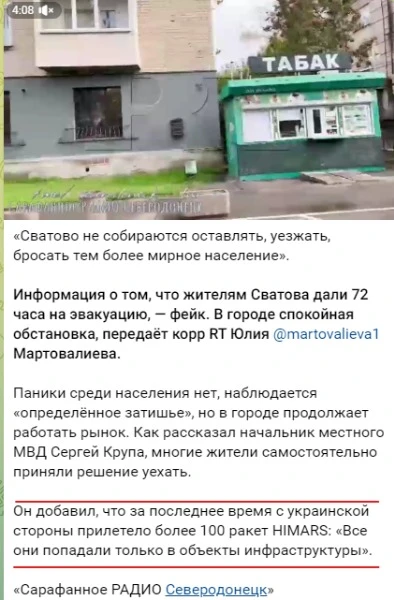
Another local propaganda resource "Sarafannoe Radio Sievierodonetsk" with reference to the leader of the "Svatove Ministry of Internal Affairs" Serhii Krupa wrote that in a few days "more than 100 HIMARS missiles had been launched to Svatove and that all of them had hit "only infrastructure objects". Following their logic, Ukraine used particularly valuable ammunition that cost at least 10.5 million dollars (the cost of the GMLRS to HIMARS missile is from 105-150 thousand dollars, depending on the year of manufacture), in order to destroy civilian objects on its own territory, which, moreover, the government had built before. And this is only in Svatove raion in a few days. In addition, it should be taken into account that there are not many MLRS of this type in the arsenal of the Armed Forces of Ukraine and not all of them are focused on this direction, and the use of high-precision GMLRS in such a quantity in one small area is simply impractical.
A few days later, the occupiers posted a video with a detained local resident who allegedly corrected the artillery of the Armed Forces of Ukraine at the Ice Palace of Sports in Sievierodonetsk.
"The customer was not interested in the location of our facilities or warehouses with ammunition, only civilian infrastructure was a target. Denys is shaking when he talks about what he did. However, he felt no guilt when decided to pass coordinates for missile strikes over the city. For example, when he directed the artillery of the Armed Forces of Ukraine on the Ice Palace, where piles of burnt baby food, medicines, and diapers are still lying," the report says.
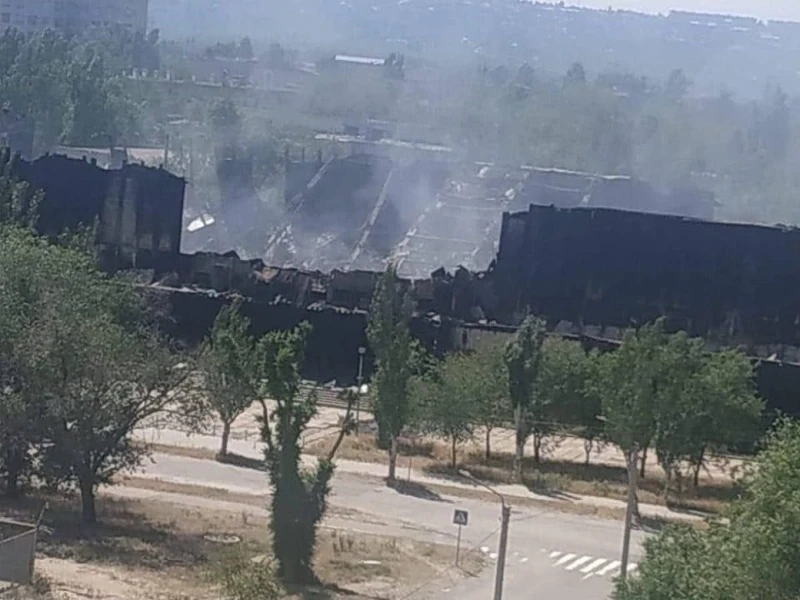
In fact, the Ice Palace of Sports was completely destroyed by the Russians during the fighting for the city on June 9. And before that, the Ukrainian humanitarian headquarters was located there, which the occupiers repeatedly fired at. One of the volunteers of this headquarters was injured and he is still undergoing treatment.
How do the occupiers "restore" cities?
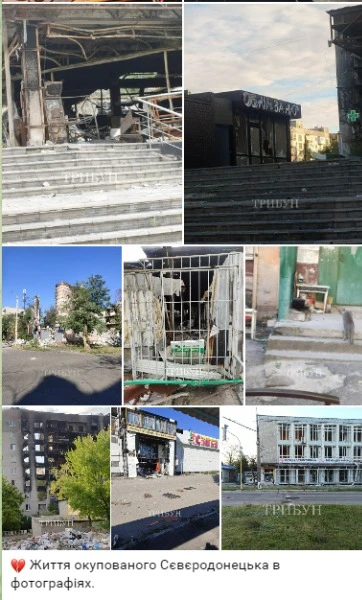
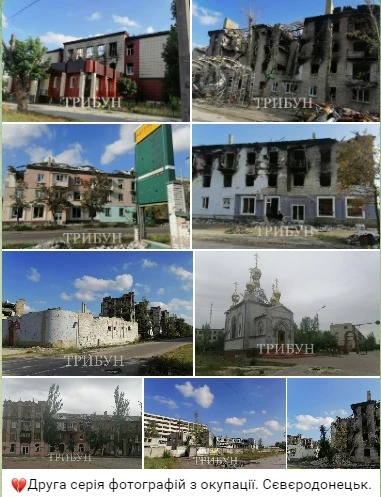
On October 6, the head of the occupation administration of Sievierodonetsk, Mykola Morhunov said that the city was "living a normal life" and all communal services were "working". However, as we can see in numerous publications on social networks - the city is destroyed, communications have been restored only in some places, there is a shortage of products and medicines. Educational institutions do not work normally.
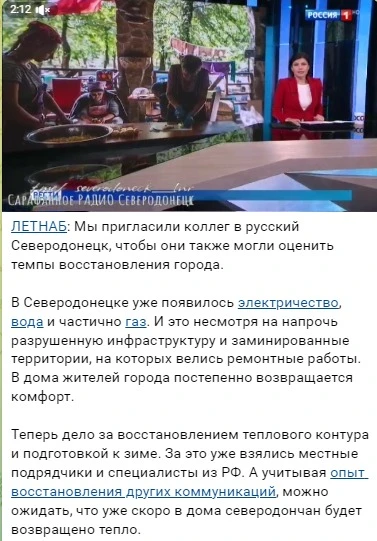
"There is electricity, water and partly gas supply in Sievierodonetsk. And this despite the completely destroyed infrastructure and mined areas, where repair works were carried out. Comfort is gradually returning to the residents of the city," − said Morhunov.
However, as we can see in numerous publications on social networks - the city is destroyed, communications have been restored only in some places, there is a shortage of products and medicines. Educational institutions do not work normally.
"Now it's time to restore the heat circuit and prepare for winter. Local contractors and specialists from the Russian Federation have already started taking necessary actions. And taking into account the experience of restoring other public utilites, we can expect that heat supply will be restored in Sievierodonetsk soon". − the occupiers said the next day, supporting the post with a story from a Russian propaganda channel.
In fact, the situation in the cities of Luhansk oblast is somewhat different.
Artem, a resident of Lysychansk, says that the occupation local authorities have a new "deadline" for restoring public utilities. Now they promise to run gas throughout the city before the beginning of winter. He confirms that there is still no water and electricity supply in his flat in Lysychansk, and he cooks food on a campfire.
Head of Luhansk regional military administration Serhiy Hayday notes that even after the de-occupation of the cities of Luhansk oblast, in which the heating system is destroyed, the citizens should not be allowed to stay there for a long time in winter - it will be impossible to live in flats where will be cold.
"After the de-occupation, we will not let people freely go to Sievierodonetsk, Lysychansk, and Rubizhne, because it will be impossible to restore the heating system there. Even having no financing problems, it will take several months to restore it. Therefore, we will give people the opportunity to come, look at their apartments, pick up their things, but they cannot stay there in winter," Serhiy Hayday said.
According to him, it will be possible to spend the winter only in the villages.
"It will be a little easier for people in rural areas. However, we will limit people′s self-willed movement to forests, because everything there can be mined. We will identify areas of the forest that were affected by fires two years ago, clear them of mines, cut firewood and distribute it to people. In addition, together with international partners, we are preparing heaters for people who decide to spend the winter in the cities," Hayday mentioned.


